



Pursuant to Section 1, Clause 5, Sub-clause (a) of the Law on the Prevention of Money Laundering and Terrorism and Proliferation Financing (hereinafter – the Law), a beneficial owner (hereinafter – BO) is a natural person who owns or controls a legal person, or on whose behalf, for whose benefit or in whose interests a business relationship is established or an occasional transaction is carried out. In relation to legal persons, this is at least a natural person who, through direct or indirect ownership, owns more than 25% of the capital shares or voting shares of the legal person, or who directly or indirectly controls it.
The said provision sets out the identifying characteristics of a BO, namely that the BO is always a natural person who owns, or in whose interests the particular legal person has been established or operates, or who directly or indirectly exercises control over the legal person. It should be noted that in the case of direct ownership or control, the BO controls the legal person directly, whereas in the case of indirect ownership or control, control is exercised through another person, whether natural or legal.
In the FATF Guidance on Beneficial Ownership of Legal Persons, published by the Financial Action Task Force (FATF) in March 2023, a BO is explained as the natural person who ultimately owns or controls a “customer” and/or the natural person on whose behalf a transaction is being conducted. The definition also includes those persons who exercise ultimate effective control over a legal person. The terms “ultimately owns or controls” and “ultimate effective control” refer to situations where ownership or control is exercised through ownership or by other means of control, which are not direct control. An essential feature of the BO definition is that it goes beyond formal ownership and legal control. FATF focuses on the natural person who actually owns the legal person and exercises the powers of its senior management or uses its assets, as well as on the natural person who actually exercises control, irrespective of the official position held.
The Law does not contain specific rules regarding these obligations depending on the nature, type or purpose of the legal person’s activities.
The definition of a capital company is laid down in Section 134 of the Commercial Law. A capital company is a commercial company whose share capital consists of the total nominal value of capital shares or shares. A capital company is a limited liability company or a joint stock company. A limited liability company is a closed company whose capital shares are not subject to public circulation, whereas a joint stock company is an open company whose shares may be subject to public circulation. Therefore, the BO of a capital company is primarily identified by determining the direct or indirect owners of the capital shares or shares.
Taking into account the definition of a BO, in capital companies a BO can always be identified in cases where more than 25% of the capital shares or shares of the capital company are owned, directly or indirectly, by at least one natural person. Unless that natural person acts on behalf of another natural person, he or she is the BO of the respective capital company. It is also clear that if several natural persons in the capital company meet the above description, all such persons are to be considered BOs of the capital company.
It should be noted that the 25% threshold referred to in the Law is the absolute minimum at which a BO can always be identified. At the same time, in practice there may be many different situations where actual control over a capital company is exercised in other ways.
Example No. 1: Several shareholders or members have agreed on the manner of exercising voting rights, including, but not limited to:
- agreeing that one shareholder or member will always vote in the same way as another shareholder or member;
- agreeing that a shareholder or member with a large proportion of shares or capital shares will not participate in meetings, thereby allowing a shareholder or member with a smaller proportion to effectively make decisions;
- agreeing on the right to appoint, individually, the majority of the members of the supervisory board or management board, etc.
Example No. 2: There may also be a situation where one natural person directly or indirectly owns less than 25% of the capital shares or shares, but the percentage of capital shares or shares held by the other shareholders or members is so small, and those shareholders or members do not in fact attend shareholders’ or members’ meetings, that it can be established that the natural person with the largest percentage of capital shares or shares actually controls the capital company.
Example No. 3: Control in a capital company may also be established where several shareholders or members are legal persons that are, in turn, controlled by one and the same natural person. In such a situation, that natural person may be recognised as the BO, taking into account his or her actual ability to exercise voting rights or influence decision-making in all the relevant legal persons as a whole.
It should be noted that it is not possible to provide an exhaustive list of all possible forms of control, as each case is individual. The management board of the legal person has a duty to verify and determine whether any natural person exercises actual control over the legal person.
In addition, it should be taken into account that if the owner of the capital shares or shares of a capital company is a legal arrangement, such as a type of legal entity not recognised in the Republic of Latvia, for example a trust, the BO must be identified in accordance with the definition of a BO laid down in Section 1, Clause 5, Sub-clause (b) of the Law. Pursuant to that provision, a BO is a natural person who owns or in whose interests a legal arrangement has been established or operates, or who directly or indirectly exercises control over it, including the settlor, trustee or manager, protector, if any, beneficiary or, where the natural persons who are beneficiaries have not yet been determined, the group of persons in whose interests the legal arrangement has been established or operates, as well as any other natural person who directly or indirectly controls the legal arrangement.
It should be noted that a legal person is a legal fiction behind which, in each case, there are natural persons who organise, manage or control it. Therefore, there cannot be a situation where no BO exists; it may only be impossible to identify the BO in accordance with the definition laid down in the Law. Consequently, the Law does not provide for the registration, in the registers maintained by the Enterprise Register, of information stating that a legal person has no BO.
Where a capital company has used all possible means of identification and has concluded that it is not possible to identify any natural person as the BO in accordance with the definition, and any doubts that the capital company has a BO have been excluded, this must be confirmed in the application, stating the grounds for such confirmation.
At the same time, it should be taken into account that where it is not possible to identify the BO of a legal person, pursuant to Section 18, Paragraph seven of the Law, the obliged entities referred to in Section 3 of the Law, such as credit institutions, outsourced accountants, sworn notaries and others, may consider the person who holds a position in the senior management body of that legal person to be the BO of the legal person. Accordingly, where information has been registered with the Enterprise Register that it is not possible to identify the BO of a legal person, the legal person, when completing customer due diligence questionnaires, for example at a credit institution, will have to indicate one, several or all members of the management board as the BO, taking into account the assessment of the relevant obliged entity regarding the material circumstances.
It should be noted that if the sole member or shareholder of a capital company is a legal person whose BO cannot be identified, it is, in general, nevertheless possible to identify the BO of the capital company itself. Namely, unless there are special internal conditions regarding decision-making, the persons authorised to represent the respective member or shareholder control decision-making in the capital company and should therefore be considered the BOs of that capital company.
Pursuant to Section 18.2, Paragraph six of the Law, if the shares of the final entity of a capital company – a joint stock company – are admitted to trading on a regulated market and control over the company derives solely from the status of a shareholder, the company is not obliged to submit information on the BO to the Enterprise Register, provided that the relevant information on shareholders is already available in accordance with the procedure established for the regulated market. This exception does not apply to situations where the BO cannot be identified for other objective reasons. It applies only to cases where information on shareholders is publicly available in accordance with the laws and regulations governing the regulated market. At the same time, the exception provided for in the Law applies only where control over the legal person can be explained solely by participation in a company listed on a regulated market and there are no other mechanisms through which control is exercised, or other legal persons through which the BO exercises control. In other words, control over the legal person must arise from the natural person’s status as a shareholder in a company listed on a regulated market. If control is exercised through a legal person and/or a legal arrangement, the preconditions for applying the exception are not met.
Identification of the BO
In accordance with the procedure laid down in Section 18.1 of the Law, a natural person who has reason to believe that he or she has become the BO of a capital company is obliged to notify the capital company of this fact. Likewise, members or shareholders of a capital company, if they act on behalf of another person, are obliged to disclose this to the management board of the capital company. The management board of the capital company has a duty, where there are reasonable grounds, to determine whether the capital company has a BO, as well as to verify whether the information received or identified regarding the BO is true and corresponds to the actual circumstances.
Deadlines
Pursuant to Section 18.1, Paragraph four and Section 18.2, Paragraph one of the Law, a capital company must immediately, but not later than within 14 days from getting to know the relevant information, submit to the Enterprise Register of the Republic of Latvia an application for the registration of information on the BO.
It should be noted that, pursuant to the first sentence of Section 18.2, Paragraph two of the Law, when submitting an application to the Enterprise Register of the Republic of Latvia for the registration or incorporation of a capital company, or for changes in the members or shareholders of the capital company or in the members of the management board, the application must include information on the BO of the capital company in accordance with the requirements of Section 18.2 of the Law.
In view of the above:
- when registering a new capital company, information on the BO must also be included in the application for registration;
- when submitting an application for changes in the composition of the members or shareholders of a capital company or in the composition of the management board, the application must include information on the BO;
- a capital company must immediately, but not later than within 14 days from getting to know information on the BO or changes in such information, submit to the Enterprise Register of the Republic of Latvia an application for the registration of information on the BO or for the registration of the respective changes.
Information to be submitted
The information on the BO to be retained by the capital company is specified in Section 18.1, Paragraph four of the Law. Pursuant to Section 18.2, Paragraph one of the Law, the same information must also be submitted to the Enterprise Register of the Republic of Latvia.
Upon request of the Enterprise Register of the Republic of Latvia, in order to ascertain the credibility of the information submitted, the capital company must provide:
- the documentary justification of the control exercised;
- a document confirming the compliance of the information identifying the BO, namely:
- a notarised copy of the personal identification document;
- a statement from a foreign population register;
- other documents equivalent to the above-mentioned documents;
- a document substantiating the confirmation that it is not possible to identify the BO.
It should be noted that, pursuant to Section 18.1, Paragraph four of the Law, information on the BO, including the documentary justification of the control exercised, must also be retained by the legal person itself.
The following information regarding the BO of a capital company must be registered in the registers maintained by the Enterprise Register:
- name;
- surname;
- personal identity number or, if the person has no personal identity number, the date, month and year of birth, the number and date of issue of the personal identification document, and the country and authority that issued the document;
- nationality or nationalities;
- country of permanent residence;
- manner in which control over the capital company is exercised:
- through a status in the legal person, if the BO is the direct owner or directly controls the legal person:
- as a member;
- as a shareholder;
- as a separate person who controls, if the BO is the indirect owner or indirectly controls the capital company:
- on the basis of an authorisation agreement;
- on the basis of an ownership right, for example, where the BO is the owner of the legal person that is a member or shareholder of the capital company;
- on the basis of a business relationship;
- through a legal arrangement as a settlor;
- through a legal arrangement as a trustee or manager;
- through a legal arrangement as a protector, if any;
- through a legal arrangement as a beneficiary or class of beneficiaries;
- other manner of control, namely a free text field allowing an undefined type of control to be entered;
- through a status in the legal person, if the BO is the direct owner or directly controls the legal person:
- extent of the control exercised;
- information regarding the person through whom control is exercised, to be indicated if any of the manners of exercising control referred to in Sub-paragraph 6.2 or 6.3 is indicated:
- for a natural person – name, surname and personal identity number or, if the person has no personal identity number, the date, month and year of birth;
- for a legal person, including a foreign legal person – name, registration number and registered address.
It should be noted that the threshold of more than 25% laid down in Section 1, Clause 5, Sub-clause (a) of the Law, where the capital shares are owned by a natural person, is the minimum threshold from which the identification of a BO is mandatory. In other words, where a natural person holds participation in such an amount, there can be no objection that the BO cannot be identified or that the respective person is not the BO. An exception is possible only where the respective natural person is controlled by another person or where another form of control exists, for example an agreement on the allocation of control among the members or shareholders.
In view of the above, where several members or shareholders of a capital company meet the above definition of a BO, there cannot be a situation where only one of those members or shareholders exercises control over the capital company through their status in the legal person – as a member or as a shareholder. In such situations, there must also be another manner of exercising control, which must be indicated in the application for the registration of the BO, including information regarding the person through whom control is exercised.
Pursuant to the second sentence of Section 18.2, Paragraph two of the Law, if a capital company has used all possible means of identification and has concluded that it is not possible to identify any natural person as the BO, and any doubts that the capital company has a BO have been excluded, this must be confirmed in the application, stating the grounds for such confirmation. In such a case, information will be registered in the Commercial Register that it is not possible to identify the BO.
1.Enterprise Register changes its practice regarding the registration of beneficial owners. Available at: Enterprise Register changes its practice regarding the registration of beneficial owners
2.Decision No. 1-5n/85 of 18 June 2026 of the Chief State Notary of the Enterprise Register. Available at: Decision No. 1-5n/85 of 18 June 2026
Considering that the Commercial Register maintained by the Enterprise Register of the Republic of Latvia also registers public capital companies (state-owned and municipal capital companies), i.e. capital companies in which all capital shares or voting shares are owned by a single public person, the following should be noted.
Pursuant to Section 1, Clause 1 and Clause 2 of the State Administration Structure Law, a public person is the Republic of Latvia as the original legal person governed by public law, as well as derived public persons. Public persons operate in accordance with the principles of public law. A derived public person is a local government or another public person established by or on the basis of a law, which has been granted its own autonomous competence by law, including the right to prepare and approve its own budget, and which may own property.
In view of the above, and taking into account the definition of a public person, it is not possible to identify a beneficial owner (hereinafter – BO) in state-owned or municipal capital companies, provided that the capital company operates in accordance with the applicable laws and regulations. A public person is not a private natural person, and therefore it is not possible to attribute to it the control of a natural person, which is required for the application of the definition of a BO.
Accordingly, where it is not possible to identify a BO of a state-owned or municipal capital company, the application for the registration of BO information must include a confirmation that the identification of the BO is not possible, together with the grounds for such conclusion, while assuming responsibility for the truthfulness of the information provided.
Pursuant to Section 1, Clause 5, Sub-clause (a) of the Law on the Prevention of Money Laundering and Terrorism and Proliferation Financing (hereinafter – the Law), a beneficial owner (hereinafter – the BO) is a natural person who owns or controls a legal person, or on whose behalf, for whose benefit or in whose interests a business relationship is established or an occasional transaction is carried out. In relation to legal persons, this is at least a natural person who, through direct or indirect ownership, owns more than 25% of the capital shares or voting shares of the legal person, or who directly or indirectly controls it. By analogy, the 25% threshold may also be applied when determining a significant level of participation in other types of legal persons, not only capital companies.
The said provision sets out the identifying characteristics of a BO, namely that the BO is always a natural person who owns, or in whose interests the particular legal person has been established or operates, or who directly or indirectly exercises control over the legal person. It should be noted that in the case of direct ownership or control, the BO controls the legal person directly, whereas in the case of indirect ownership or control, control is exercised through another person, whether natural or legal.
In the FATF Guidance on Beneficial Ownership of Legal Persons published by the Financial Action Task Force (FATF) in March 2023, a BO is explained as the natural person who ultimately owns or controls a “customer” and/or the natural person on whose behalf a transaction is being conducted. The definition also includes those persons who exercise ultimate effective control over a legal person. The terms “ultimately owns or controls” and “ultimate effective control” refer to situations where ownership or control is exercised through ownership or by other means of control, which are not direct control. An essential feature of the BO definition is that it goes beyond formal ownership and legal control. FATF focuses on the natural person who actually owns the legal person and exercises the powers of its senior management or uses its assets, as well as on the natural person who actually exercises control, irrespective of the official position held.
The Law does not contain specific rules regarding the obligations referred to above depending on the nature, type or purpose of the legal person’s activities.
The fundamental principles governing the operation of cooperative societies are laid down in Section 3 of the Cooperative Societies Law. Pursuant to that provision, a cooperative society is managed by its members, who actively and democratically participate in its governance, and each member has one vote at the general meeting of members. The capital of a cooperative society is formed and controlled by its members, who also share the profits generated by the cooperative society. Taking the above into account and applying the aforementioned participation threshold by analogy, in cooperative societies with two or three members who are natural persons, those natural persons should be regarded as the BOs. If such members exercise control in the cooperative society on behalf of another person, the BO should be the respective natural person on whose behalf the member acts. If a cooperative society has two or three members that are legal persons, the BOs should be the natural persons who, through those legal persons, indirectly control the cooperative society.
It should be noted that the 25% threshold referred to in the Law is the absolute minimum at which a BO can always be identified. At the same time, in practice there may be many different situations where actual control over a cooperative society is exercised in other ways.
Example No. 1: Several members have agreed on the manner of decision-making, including, but not limited to:
- agreeing that one member will always make decisions in the same way as another member;
- agreeing that certain members will refrain from participating in decision-making in order to allow another member to make decisions;
- agreeing that one member has the right to unilaterally prevent other members from exercising representation rights, etc.
Example No. 2: Control in a cooperative society may also be established where the members are legal persons controlled by one and the same natural person.
In all other cases, it must be assessed whether there are natural persons who, in accordance with Section 1, Clause 5, Sub-clause (a) of the Law, exercise control over the respective cooperative society. It should be noted that it is not possible to provide an exhaustive description of all possible situations, as each case is individual, and the management board of the legal person has a duty to ascertain whether any natural person exercises actual control over the respective legal person.
In addition, it should be taken into account that if the owner of a legal person that is a member of a cooperative society is a legal arrangement (for example, a type of legal entity not recognised in the Republic of Latvia, such as a trust), the BO must be identified in accordance with the definition laid down in Section 1, Clause 5, Sub-clause (b) of the Law. Pursuant to that provision, a BO is a natural person who owns or in whose interests a legal arrangement has been established or operates, or who directly or indirectly exercises control over it, including the settlor, trustee (manager), protector (if any), beneficiary or, where the natural persons who are beneficiaries have not yet been determined, the group of persons in whose interests the legal arrangement has been established or operates, as well as any other natural person who directly or indirectly controls the legal arrangement.
It should be noted that a legal person is a legal fiction behind which, in each case, there are natural persons who organise, manage or control it. Therefore, there cannot be a situation where no BO exists; it may only be impossible to identify the BO in accordance with the definition laid down in the Law. Consequently, the Law does not provide for the registration in the registers maintained by the Enterprise Register of information stating that a legal person has no BO.
Identification of the BO
In accordance with the procedure laid down in Section 18.1 of the Law, a natural person who has reason to believe that he or she has become the BO of a cooperative society is obliged to notify the cooperative society of this fact. Likewise, members of a cooperative society who act on behalf of another person are obliged to disclose this fact to the management board of the cooperative society. The management board of the cooperative society has a duty, where there are reasonable grounds, to determine whether the cooperative society has a BO and to verify whether the information received or identified regarding the BO is true and corresponds to the actual circumstances.
Deadlines
Pursuant to Sections 18.1(4) and 18.2(1) of the Law, a cooperative society must immediately, but not later than within 14 days from getting to know the relevant information, submit to the Enterprise Register of the Republic of Latvia an application for the registration of information on the BO.
It should be noted that, pursuant to the first sentence of Section 18.2(2) of the Law, when submitting an application to the Enterprise Register of the Republic of Latvia for the registration (incorporation) of a cooperative society or for changes in the members of the management board, the application must contain information on the BO of the cooperative society in accordance with the requirements of Section 18.2 of the Law.
In view of the above:
- when registering a new cooperative society, information on the BO must also be included in the registration application;
- when submitting an application for changes in the composition of the management board of a cooperative society, the application must include information on the BO;
- a cooperative society must immediately, but not later than within 14 days from getting to know information on the BO or changes in such information, submit to the Enterprise Register of the Republic of Latvia an application for the registration of information on the BO or for the registration of the respective changes.
Information to be submitted
The information on the BO to be retained by a cooperative society is specified in Section 18.1(4) of the Law. Pursuant to Section 18.2(1) of the Law, the same information must also be submitted to the Enterprise Register of the Republic of Latvia.
Upon request of the Enterprise Register of the Republic of Latvia, in order to ascertain the credibility of the information submitted, the cooperative society must provide:
- the documentary justification of the control exercised;
- a document confirming the compliance of the information identifying the BO:
- a notarised copy of the personal identification document;
- a statement from a foreign population register;
- other documents equivalent to the above-mentioned documents;
- a document substantiating the confirmation that it is not possible to identify the BO.
It should be noted that, pursuant to Section 18.1(4) of the Law, information on the BO, including the documentary justification of the control exercised, must also be retained by the legal person itself.
The following information regarding the BO of a cooperative society must be registered in the registers maintained by the Enterprise Register of the Republic of Latvia:
- name;
- surname;
- personal identity number (or, if the person has no personal identity number, the date, month and year of birth, the number and date of issue of the personal identification document, and the country and authority that issued the document);
- nationality or nationalities;
- country of permanent residence;
- manner in which control over the cooperative society is exercised:
- through a status in the legal person (if the BO is the direct owner or directly controls the legal person):
- as a member of the cooperative society;
- as a representative of the executive or administrative body;
- as a separate person who controls (if the BO is the indirect owner or indirectly controls the cooperative society):
- on the basis of an authorisation agreement;
- on the basis of an ownership right (for example, where the BO of the cooperative society is the owner of a legal person that is a member of the cooperative society);
- on the basis of a business relationship;
- through a legal arrangement as a settlor;
- through a legal arrangement as a trustee (manager);
- through a legal arrangement as a protector (if any);
- through a legal arrangement as a beneficiary or class of beneficiaries;
- other manner of control (free text field enabling an undefined form of control to be entered);
- through a status in the legal person (if the BO is the direct owner or directly controls the legal person):
- extent of the control exercised;
- information regarding the person through whom control is exercised (to be indicated if any of the forms of control referred to above are used):
- for a natural person – name, surname and personal identity number (or, if the person has no personal identity number, the date, month and year of birth);
- for a legal person (including a foreign legal person) – name, registration number and registered address.
Pursuant to the second sentence of Section 18.2(2) of the Law, if a cooperative society has used all possible means of identification and has concluded that it is not possible to identify any natural person as the BO, and any doubts that the cooperative society has a BO have been excluded, this must be confirmed in the application, stating the grounds for such confirmation. In such a case, information will be registered in the Commercial Register that it is not possible to identify the BO.
Pursuant to Section 1, Clause 5, Sub-clause (a) of the Law on the Prevention of Money Laundering and Terrorism and Proliferation Financing (hereinafter – the Law), a beneficial owner (hereinafter – the BO) is a natural person who owns or controls a legal person, or on whose behalf, for whose benefit or in whose interests a business relationship is established or an occasional transaction is carried out. In relation to legal persons, this is at least a natural person who, through direct or indirect ownership, owns more than 25% of the capital shares or voting shares of the legal person, or who directly or indirectly controls it. By analogy, the 25% threshold may also be applied when determining a significant level of participation in other types of legal persons, not only capital companies.
The said provision sets out the identifying characteristics of a BO, namely that the BO is always a natural person who owns, or in whose interests the particular legal person has been established or operates, or who directly or indirectly exercises control over the legal person. It should be noted that in the case of direct ownership or control, the BO controls the legal person directly, whereas in the case of indirect ownership or control, control is exercised through another person, whether natural or legal.
In the FATF Guidance on Beneficial Ownership of Legal Persons published by the Financial Action Task Force (FATF) in March 2023, a BO is explained as the natural person who ultimately owns or controls a “customer” and/or the natural person on whose behalf a transaction is being conducted. The definition also includes those persons who exercise ultimate effective control over a legal person. The terms “ultimately owns or controls” and “ultimate effective control” refer to situations where ownership or control is exercised through ownership or by other means of control which are not direct control. An essential feature of the BO definition is that it goes beyond formal ownership and legal control. FATF focuses on the natural person who actually owns the legal person and exercises the powers of its senior management or uses its assets, as well as on the natural person who actually exercises control, irrespective of the official position held.
The Law does not contain specific rules regarding the obligations referred to above depending on the nature, type or purpose of the legal person's activities.
The fundamental principles governing the operation of a farmer’s farm and a fisherman’s farm are laid down in Chapter II of the Law “On Individual (Family) Enterprises and Farmer’s or Fisherman’s Farms”. Pursuant to these provisions, in individual enterprises, as well as in farmer’s and fisherman’s farms, the BO will almost always be the owner. An exception may arise where another natural person effectively controls the owner, meaning that the owner controls the enterprise on behalf of another natural person. In such a case, the controlling natural person should be regarded as the BO.
Deadlines
Pursuant to Sections 18.1(4) and 18.2(1) of the Law, a legal person must immediately, but no later than within 14 days from becoming aware of the relevant information, submit an application to the Enterprise Register of the Republic of Latvia for the registration of information regarding the BO.
Accordingly:
- when registering a new individual enterprise, farmer’s farm or fisherman’s farm, information regarding the BO must also be included in the registration application;
- an individual enterprise, farmer’s farm or fisherman’s farm must immediately, but no later than within 14 days from becoming aware of information regarding the BO or any changes thereto, submit an application to the Enterprise Register of the Republic of Latvia for the registration of the BO information or the registration of the respective changes.
Information to be Submitted
The information regarding the BO that must be retained by the legal person is specified in Section 18.1(4) of the Law. Pursuant to Section 18.2(1) of the Law, the same information must also be submitted to the Enterprise Register of the Republic of Latvia.
Upon request of the Enterprise Register of the Republic of Latvia, an individual enterprise, farmer’s farm or fisherman’s farm must provide:
- documentary evidence of the control exercised;
- documents confirming the BO’s identity:
- a notarised copy of a personal identification document;
- a statement from a foreign population register;
- other documents equivalent to the above-mentioned documents.
It should be noted that, pursuant to Section 18.1(4) of the Law, information regarding the BO, including documentary evidence of the control exercised, must also be retained by the legal person itself.
The following information regarding the BO of an individual enterprise, farmer’s farm or fisherman’s farm must be registered in the registers maintained by the Enterprise Register of the Republic of Latvia:
- given name;
- surname;
- personal identity number (or, if the person has no personal identity number, date of birth, month and year of birth, number and date of issue of the personal identification document, and the country and authority that issued the document);
- nationality or nationalities;
- country of permanent residence;
- manner in which control over the enterprise is exercised:
- through a status in the legal person (if the BO is the direct owner or directly controls the legal person):
- as the owner;
- as a separate controlling person (if the BO indirectly controls the owner of the enterprise):
- on the basis of an authorisation agreement;
- on the basis of ownership rights;
- on the basis of a business relationship;
- other manner of control (free-text field allowing an undefined type of control to be entered);
- through a status in the legal person (if the BO is the direct owner or directly controls the legal person):
- extent of the control exercised;
- information regarding the person through whom control is exercised (to be provided where one of the forms of indirect control referred to above is indicated):
- for a natural person – given name, surname and personal identity number (or, where no personal identity number exists, date, month and year of birth).
Pursuant to Section 1, Clause 5, Sub-clause (a) of the Law on the Prevention of Money Laundering and Terrorism and Proliferation Financing (hereinafter – the Law), a beneficial owner (hereinafter – the BO) is a natural person who owns or controls a legal person, or on whose behalf, for whose benefit or in whose interests a business relationship is established or an occasional transaction is carried out. In relation to legal persons, this is at least a natural person who, through direct or indirect ownership, owns more than 25% of the capital shares or voting shares of the legal person, or who directly or indirectly controls it. By analogy, the 25% threshold may also be applied when determining a significant level of participation in other types of legal persons, not only capital companies.
The said provision sets out the identifying characteristics of a BO, namely that the BO is always a natural person who owns, or in whose interests the particular legal person has been established or operates, or who directly or indirectly exercises control over the legal person. It should be noted that in the case of direct ownership or control, the BO controls the legal person directly, whereas in the case of indirect ownership or control, control is exercised through another person, whether natural or legal.
In the FATF Guidance on Beneficial Ownership of Legal Persons published by the Financial Action Task Force (FATF) in March 2023, a BO is explained as the natural person who ultimately owns or controls a “customer” and/or the natural person on whose behalf a transaction is being conducted. The definition also includes those persons who exercise ultimate effective control over a legal person. The terms “ultimately owns or controls” and “ultimate effective control” refer to situations where ownership or control is exercised through ownership or by other means of control which are not direct control. An essential feature of the BO definition is that it goes beyond formal ownership and legal control. FATF focuses on the natural person who actually owns the legal person and exercises the powers of its senior management or uses its assets, as well as on the natural person who actually exercises control, irrespective of the official position held.
Indirect control may be exercised through various means, including contractual arrangements, the exercise of dominant influence (for example, by a member or board member of an association), financing of the association, family relationships, or other contractual relationships that provide significant actual influence. Members of an association may also cooperate with one another in order to increase indirect control through another person, including by entering into formal or informal agreements coordinating voting rights or decision-making, or by exercising their powers to appoint the senior management of the association, thereby obtaining decisive influence over its governance.
The Law does not contain specific rules regarding the obligations referred to above depending on the nature, type or purpose of the legal person's activities. It should also be noted that a legal person is a legal fiction behind which there are always natural persons who organise, manage or control it. Accordingly, there cannot be a situation where no BO exists; it may only be impossible to identify the BO in accordance with the definition laid down in the Law. Therefore, the Law does not provide for the registration of information stating that a legal person has no BO.
Where members exercise their rights solely in their capacity as members and in accordance with the rights and obligations laid down in the Associations and Foundations Law, such members should not be regarded as BOs. An example of a situation where members do not act solely in their capacity as members would be where they pursue objectives other than those set out in the association’s articles of association.
It should be taken into account that the purpose of an association is defined in its articles of association, must comply with the Constitution, laws and international treaties binding upon Latvia, and may be directed either towards the public benefit or towards the interests of its members. Furthermore, an association is not required to be registered as a public benefit organisation in order for its purpose to serve the public interest.
Where members act primarily for the achievement of their own separate interests, the number of members must also be taken into account. Accordingly, where members exercise their rights solely as members and the association’s purpose serves the public benefit, or where the purpose serves the interests of its members but the number of members is large, it will generally not be possible to identify a BO unless the legal person is in fact controlled, within the meaning of the BO definition, by one or more specific natural persons.
Example No. 1: Where the objectives of an association are directed towards a broad group of persons, it will generally not be possible to identify a BO unless the association is in fact controlled by one or more specific natural persons. In such a case, the number of members is irrelevant.
Example No. 2: Where the objectives of an association are directed towards the interests of its members and the number of members is large, it will generally not be possible to identify a BO unless the association is in fact controlled by one or more specific natural persons.
Example No. 3: Where the objectives of an association are directed towards the interests of its members and the number of members is small (up to four members), those members should generally be indicated as the BOs, unless the association is in fact controlled by other specific natural persons.
Accordingly, when identifying the BO of an association, significant importance must be attached to the purpose of the association – whether its activities are directed towards the public benefit or the interests of its members – as well as to the number of active members.
By analogy, taking into account the legal definitions of trade unions and political parties, as well as the requirements regarding their objectives and membership, a similar approach applies to these legal persons. Accordingly, where members exercise their rights solely in their capacity as members of the relevant organisation, it will generally not be possible to identify a BO unless the association, trade union or political party is in fact controlled by one or more specific natural persons, such as members of its executive body.
For example, this may occur where members no longer actively exercise their membership rights and, in substance, the organisation is managed solely by members of its executive body, all decisions are taken and transactions carried out in the interests and for the benefit of one or more specific persons rather than in pursuit of the objectives of the organisation and the interests of its members. Such persons may be members, founders or executive body members (direct control), or they may be persons who are neither founders, members nor executive body members (indirect control). Control may also be presumed where, for example, a person uses and derives benefit from the organisation’s financial assets even if such control is not formally exercised.
Accordingly, each legal person must be assessed individually in light of the actual circumstances in order to determine whether there is a natural person exercising control over that legal person. In the majority of associations, trade unions and political parties, however, it will not be possible to identify a BO.
Where an association, trade union or political party has used all possible means of identification and has concluded that it is not possible to identify any natural person as the BO, and any doubts that such a BO exists have been excluded, this must be confirmed in the application, stating the grounds for that conclusion.
At the same time, it should be taken into account that where it is not possible to identify the BO of a legal person, the obliged entities referred to in Section 3 of the Law (for example, credit institutions, outsourced accountants, sworn notaries and others) may, pursuant to Section 18(7) of the Law, regard the person holding a position in the senior management body of the legal person as its BO. Accordingly, where information has been registered with the Enterprise Register that it is not possible to identify the BO of a legal person, that legal person may be required, when completing customer due diligence questionnaires (for example, for a credit institution), to indicate one, several or all members of its management board as BOs, depending on the assessment of the relevant obliged entity.
Identification of the BO
As with other legal persons, if a natural person has reason to believe that he or she has become the BO of an association, trade union or political party, that person is required, pursuant to Section 18.1 of the Law, to notify the relevant legal person.
The management of the association, trade union or political party is required, where reasonable grounds exist, to determine whether the organisation has a BO and whether the information received or identified regarding the BO is accurate.
Deadlines
Pursuant to Sections 18.1(4) and 18.2(1) of the Law, a legal person must immediately, but no later than within 14 days from becoming aware of the relevant information, submit an application to the Enterprise Register of the Republic of Latvia for the registration of information regarding the BO.
It should be noted that, pursuant to the first sentence of Section 18.2(2) of the Law, when submitting an application for the registration (establishment) of an association, trade union or political party, information regarding the BO must be provided in accordance with the requirements of Section 18.2 of the Law.
Accordingly:
- when registering a new association, trade union or political party, information regarding the BO must be included in the registration application;
- when applying for changes in the composition of the management board, information regarding the BO must be included in the application;
- an association, trade union or political party must immediately, but no later than within 14 days from becoming aware of information regarding the BO or changes thereto, submit an application for registration of such information or the relevant changes.
Information to be Submitted
The information regarding the BO that must be retained by the legal person is specified in Section 18.1(4) of the Law. Pursuant to Section 18.2(1) of the Law, the same information must also be submitted to the Enterprise Register of the Republic of Latvia.
Upon request of the Enterprise Register, an association, trade union or political party must provide:
- documentary evidence of the control exercised;
- documents confirming the BO’s identity:
- a notarised copy of a personal identification document;
- a statement from a foreign population register;
- other documents equivalent to the above-mentioned documents;
- documents substantiating the confirmation that it is not possible to identify the BO.
It should be noted that, pursuant to Section 18.1(4) of the Law, information regarding the BO, including documentary evidence of the control exercised, must also be retained by the legal person itself.
The following information regarding the BO of an association, trade union or political party must be registered in the registers maintained by the Enterprise Register of the Republic of Latvia:
- given name;
- surname;
- personal identity number (or, if the person has no personal identity number, date of birth, month and year of birth, number and date of issue of the personal identification document, and the country and authority that issued the document);
- nationality or nationalities;
- country of permanent residence;
- manner in which control over the legal person is exercised:
- through a status in the legal person:
- as a member;
- as a representative of an executive or governing body;
- as a separate controlling person (where the BO indirectly controls founders, representatives of executive bodies or governing bodies):
- on the basis of an authorisation agreement;
- on the basis of ownership rights;
- on the basis of a business relationship;
- other manner of control (free-text field enabling an undefined type of control to be entered);
- through a status in the legal person:
- extent of the control exercised;
- information regarding the person through whom control is exercised:
- for a natural person – given name, surname and personal identity number (or date of birth if no personal identity number has been assigned);
- for a legal person (including a foreign legal person) – name, registration number and registered address.
Pursuant to the second sentence of Section 18.2(2) of the Law, if an association, trade union or political party has used all possible means of identification and has concluded that it is not possible to identify any natural person as the BO, and any doubts that a BO exists have been excluded, this must be confirmed in the application, stating the grounds for such conclusion. In such a case, the relevant register will contain an entry stating that it is not possible to identify the BO.
The definition of a beneficial owner (hereinafter – the BO) set out in Section 1, Clause 5 of the Law on the Prevention of Money Laundering and Terrorism and Proliferation Financing (hereinafter – the Law) was established in accordance with Article 3(6) of Directive (EU) 2015/849 of the European Parliament and of the Council of 20 May 2015 on the prevention of the use of the financial system for the purposes of money laundering or terrorist financing (AMLD IV). Specifically, point (a) of Article 3(6) sets out the criteria to be taken into account when identifying BOs in corporate entities, i.e. legal persons whose ownership structure allows a mathematical assessment of control based on ownership thresholds.
By contrast, points (b) and (c) establish the criteria for identifying BOs in trusts and other legal entities such as foundations, as well as legal arrangements similar to trusts. In these entities, a mathematical assessment of ownership is not relevant. For the purposes of AMLD IV, the “ultimate beneficial owner” is the natural person or persons holding positions equivalent or similar to those referred to in point (b), namely the settlor, trustee(s), protector (if any), beneficiaries or class of beneficiaries, or any other natural person who ultimately exercises control over foundations or legal arrangements similar to trusts through direct or indirect ownership or by other means.
The legal system of the Republic of Latvia does not recognise trusts or similar legal arrangements and, accordingly, no trust is legally registered in Latvia. However, Latvia recognises and registers foundations, including funds, the structure and operating principles of which share characteristics equivalent to those of legal arrangements, including trusts.
One of the most important principles of a legal arrangement is the separation of assets, whereby assets constitute a separate pool of property. A similar principle is reflected in Section 2(2) of the Associations and Foundations Law, which provides that a foundation, including a fund, is a pool of assets separated for the achievement of a purpose specified by the founder and not intended for profit-making purposes. Section 86(3) of the same law provides that persons who have granted assets to a foundation after its registration are not considered founders. The Associations and Foundations Law does not require founders to contribute a specific amount of money or other property to the foundation. Accordingly, the term “pool of assets” should be understood as a structure through which funds from various sources are contributed during the lifetime of the foundation. Like a trust or similar legal arrangement, a foundation is characterised by a separation between those involved in its establishment and those exercising control over it. A foundation is also a closed organisation without members; it has only founders and supporters, separate assets, and one or more governing bodies (a complex governance structure). Furthermore, pursuant to Section 91 of the Associations and Foundations Law, a foundation may designate beneficiaries. Although legal arrangements, including trusts, are generally established rather than registered, the fact of registration does not affect their existence or operation.
| Legal Arrangement (including a Trust) | Foundation |
|---|---|
| 💰 Separation of assets | 💰 Separation of assets (Section 2(2) and Section 86(3) of the Associations and Foundations Law) |
| 👥 No members (only founders and supporters) | 👥 No members (only founders and supporters) |
| 🔒 Closed-type organisation | 🔒 Closed-type organisation |
| 👤 Trustee | 👤 Management board |
| ⚙️ Protector (if any) | ⚙️ Other governing body (if established) |
| 🎯 Beneficiaries or class of beneficiaries | 🎯 Beneficiaries or class of beneficiaries |
| 🔍 Other persons exercising control | 🔍 Other persons exercising control |
| 📜 Established (generally) | ✅ Registered |
It should also be noted that, pursuant to Article 288(3) of the Treaty on the Functioning of the European Union, a directive is binding upon Member States as to the result to be achieved while leaving national authorities the choice of form and methods. Consequently, when transposing a directive into national law, Member States may choose the appropriate methods and forms of implementation, provided that the objectives of the directive are achieved. Taking into account the definition and fundamental principles of foundations, including funds, and legal arrangements, it follows that, although a foundation is regarded as a legal person under Latvian law, for the purposes of the Law it should be assessed according to its structure, characteristics and substance as a legal arrangement. Therefore, its BOs should be identified in accordance with AMLD IV. The fact that Latvian law does not currently distinguish foundations, including funds, whose actual structure corresponds to that of a legal arrangement does not constitute a legal basis for applying the BO definition applicable to legal persons where that definition is incompatible with the nature of a foundation.
The purpose of the BO concept, both under Latvian law, European Union legislation and the international standards of the Financial Action Task Force (FATF), is to identify the natural persons who ultimately exercise effective control over a legal person or legal arrangement. Accordingly, the BO definition must be applied not only on the basis of legal status, but also on the basis of structure and substance.
At the same time, applying the BO definition applicable to legal arrangements when identifying the BOs of foundations, including funds, does not alter their legal status in Latvia. Such entities remain legal persons in their relations with third parties, together with all rights and obligations attached thereto.
Identification of the BO
As with other legal persons, where a natural person has reason to believe that he or she has become the BO of a foundation, including a fund, that person is required, in accordance with Section 18.1 of the Law, to notify the executive body of the foundation or fund accordingly. The management of the foundation or fund is required, where reasonable grounds exist, to determine whether it has a BO and whether the information received or identified regarding the BO is accurate, applying the definition set out in Section 1(5)(b) of the Law, according to which, in relation to legal arrangements, a BO is a natural person who owns or in whose interests a legal arrangement has been established or operates, or who directly or indirectly exercises control over it, including the settlor, trustee (manager), protector (if any), beneficiary or, where the beneficiaries have not yet been determined, the class of persons in whose interests the legal arrangement has been established or operates, as well as any other natural person who directly or indirectly exercises control over the legal arrangement.
Deadlines
Pursuant to Sections 18.1(4) and 18.2(1) of the Law, a legal person must immediately, but no later than 14 days after becoming aware of the relevant information, submit an application to the Enterprise Register of the Republic of Latvia for registration of BO information.
Pursuant to the first sentence of Section 18.2(2) of the Law, when submitting an application for the registration (establishment) of a foundation, including a fund, or changes in its governing body, information on the BO must also be provided in accordance with Section 18.2 of the Law.
Accordingly:
- upon registration of a new foundation or fund, information regarding the BO must be submitted;
- when applying for changes in the composition of the management board, information regarding the BO must be included or confirmation must be provided that the registered BO information remains unchanged;
- a foundation or fund must submit an application for registration of BO information, or changes thereto, immediately and no later than 14 days from becoming aware of such information.
Information to be Submitted
The information regarding the BO that must be retained by a foundation or fund is specified in Section 18.1(4) of the Law. The same information must also be submitted to the Enterprise Register pursuant to Section 18.2(1).
Upon request of the Enterprise Register, a foundation or fund must submit:
- documentary evidence of the control exercised;
- documents confirming the BO's identity, including:
- a notarised copy of an identity document;
- an extract from a foreign population register;
- other equivalent documents.
Information regarding the BO, including documentary evidence of control, must also be maintained by the legal person itself.
The following information must be recorded regarding the BO of a foundation or fund (including founders, members of the management board, members of other supervisory bodies, beneficiaries and other natural persons exercising control):
- given name;
- surname;
- personal identity number (or, where none exists, date of birth, document number, issue date, issuing country and authority);
- nationality or nationalities;
- country of residence;
- manner in which control is exercised:
- through status in the legal person:
- as founder;
- as a representative of an executive or governing body;
- as a separate controlling person (where indirect control exists):
- on the basis of an authorisation agreement;
- on the basis of ownership rights;
- on the basis of a business relationship;
- on the basis of a court decision;
- through a legal arrangement as settlor;
- through a legal arrangement as trustee (manager);
- through a legal arrangement as protector (if any);
- through a legal arrangement as beneficiary or class of beneficiaries;
- other (free-text description of the control mechanism);
- through status in the legal person:
- extent of control exercised;
- information regarding the person through whom control is exercised:
- for a natural person – name, surname and personal identity number (or date of birth);
- for a legal person (including a foreign legal person) – name, registration number and registered address.
Pursuant to Section 1, Clause 5, Sub-clause (a) of the Law on the Prevention of Money Laundering and Terrorism and Proliferation Financing (hereinafter – the Law), a beneficial owner (hereinafter – the BO) is a natural person who owns or controls a legal person (in the case of religious organisations – a religious organisation or its institution, where legal personality has been granted in accordance with the Religious Organisations Law), or on whose behalf, for whose benefit or in whose interests a business relationship is established or an occasional transaction is carried out. In relation to legal persons, this is at least a natural person who, through direct or indirect ownership, owns more than 25% of the capital shares or voting shares of the legal person, or who directly or indirectly controls it. By analogy, the 25% threshold may also be applied when determining a significant level of participation in other legal persons, not only capital companies.
The said provision sets out the identifying characteristics of a BO, namely that the BO is always a natural person who owns, or in whose interests the particular legal person has been established or operates, or who directly or indirectly exercises control over the legal person. It should be noted that in the case of direct ownership or control, the BO controls the legal person directly, whereas in the case of indirect ownership or control, control is exercised through another person, whether natural or legal.
In the FATF Guidance on Beneficial Ownership of Legal Persons published by the Financial Action Task Force (FATF) in March 2023, a BO is explained as the natural person who ultimately owns or controls a “customer” and/or the natural person on whose behalf a transaction is being conducted. The definition also includes those persons who exercise ultimate effective control over a legal person. The terms “ultimately owns or controls” and “ultimate effective control” refer to situations where ownership or control is exercised through ownership or by other means of control that are not direct control. An essential feature of the BO definition is that it goes beyond formal ownership and legal control. FATF focuses on the natural person who actually owns the legal person and exercises the powers of its senior management or uses its assets, as well as on the natural person who actually exercises control, irrespective of the official position held.
The Law does not contain specific rules regarding the obligations referred to above depending on the nature, type or purpose of the legal person's activities.
The essence of religious organisations is to unite within a particular religious denomination or religious organisation in order to carry out religious activities within a defined territory. Religious activity means devotion to a religion or belief through worship, the performance of religious or ritual ceremonies, and the preaching of religious doctrine. The conduct of religious activities does not imply that any official of a congregation may be regarded as the owner of the organisation. Accordingly, taking into account the nature and purpose of religious organisations, it will generally not be possible to identify a BO, as there is usually no natural person who owns the religious organisation, nor can one or more natural persons be identified as controlling it or as persons on whose behalf, for whose benefit or in whose interests business relationships are established or occasional transactions are carried out within the meaning of the Law.
At the same time, the above does not exclude the possibility that, in certain cases, information regarding a BO may be identified or obtained in relation to a religious organisation. In such cases, the religious organisation is obliged to submit information regarding its BO to the Enterprise Register of the Republic of Latvia within the time limits and according to the procedures laid down in the Law.
It should be noted that a legal person is a legal fiction behind which there are always natural persons who organise, manage or control it. Accordingly, there cannot be a situation where no BO exists; it may only be impossible to identify the BO in accordance with the definition laid down in the Law. Consequently, the Law does not provide for the registration of information stating that a legal person has no BO.
Where a religious organisation or its institution has used all possible means of identification and has concluded that it is not possible to identify any natural person as the BO, and any doubts that such a BO exists have been excluded, this must be confirmed in the application, stating the grounds for that conclusion.
At the same time, it should be taken into account that where it is not possible to identify the BO of a legal person, the obliged entities referred to in Section 3 of the Law (for example, credit institutions, outsourced accountants, sworn notaries and others) may, pursuant to Section 18(7) of the Law, regard the person holding a position in the senior management body of the legal person as its BO. Accordingly, where information has been registered with the Enterprise Register that it is not possible to identify the BO of a legal person, the religious organisation or its institution (where it has legal personality under the Religious Organisations Law) may be required, when completing customer due diligence questionnaires (for example, for a credit institution), to indicate one, several or all members of its governing body or officials as BOs, depending on the assessment of the relevant obliged entity.
Identification of the BO
As with other legal persons, if a natural person has reason to believe that he or she has become the BO of a religious organisation or its institution, that person is required, pursuant to Section 18.1 of the Law, to notify the religious organisation or institution accordingly. The management of the religious organisation or institution is required, where reasonable grounds exist, to determine whether it has a BO and whether the information received or identified regarding the BO is accurate.
Deadlines
Pursuant to Sections 18.1(4) and 18.2(1) of the Law, a legal person must immediately, but no later than within 14 days from becoming aware of the relevant information, submit an application to the Enterprise Register of the Republic of Latvia for the registration of information regarding the BO.
In addition, pursuant to the first sentence of Section 18.2(2) of the Law, when submitting an application for the registration (establishment) of a religious organisation or its institution, or for changes in the composition of its governing body or officials, information regarding the BO must be provided in accordance with the requirements of Section 18.2 of the Law.
Accordingly:
- when registering a new religious organisation or its institution, information regarding the BO must be included in the registration application;
- when applying for changes in the composition of the governing body or officials, information regarding the BO must be provided or confirmation must be given that the registered information has not changed;
- a religious organisation or its institution must immediately, but no later than within 14 days from becoming aware of information regarding the BO or changes thereto, submit an application for registration of such information or the relevant changes.
Information to be Submitted
The information regarding the BO that must be retained by the legal person is specified in Section 18.1(4) of the Law. Pursuant to Section 18.2(1) of the Law, the same information must also be submitted to the Enterprise Register of the Republic of Latvia.
Upon request of the Enterprise Register, a religious organisation or its institution must provide:
- documentary evidence of the control exercised;
- documents confirming the BO’s identity:
- a notarised copy of a personal identification document;
- a statement from a foreign population register;
- other documents equivalent to the above-mentioned documents;
- documents substantiating the confirmation that it is not possible to identify the BO.
It should be noted that, pursuant to Section 18.1(4) of the Law, information regarding the BO, including documentary evidence of the control exercised, must also be retained by the legal person itself.
The following information regarding the BO of a religious organisation or its institution must be registered in the registers maintained by the Enterprise Register of the Republic of Latvia:
- given name;
- surname;
- personal identity number (or, if the person has no personal identity number, date of birth, month and year of birth, number and date of issue of the personal identification document, and the country and authority that issued the document);
- nationality or nationalities;
- country of permanent residence;
- manner in which control over the religious organisation or its institution is exercised:
- through a status in the legal person (if the BO is a member of a governing body authorised to represent the religious organisation or institution):
- as a representative of an executive or governing body;
- as a separate controlling person (if the BO indirectly controls a member of the governing body authorised to represent the religious organisation or institution):
- on the basis of an authorisation agreement;
- on the basis of a business relationship;
- other manner of control (free-text field enabling an undefined type of control to be entered);
- through a status in the legal person (if the BO is a member of a governing body authorised to represent the religious organisation or institution):
- extent of the control exercised;
- information regarding the person through whom control is exercised:
- for a natural person – given name, surname and personal identity number (or date of birth where no personal identity number has been assigned);
- for a legal person (including a foreign legal person) – name, registration number and registered address.
Pursuant to the second sentence of Section 18.2(2) of the Law, if a religious organisation or its institution has used all possible means of identification and has concluded that it is not possible to identify any natural person as the BO, and any doubts that such a BO exists have been excluded, this must be confirmed in the application, stating the grounds for such conclusion. In such a case, an entry will be made in the Register of Religious Organisations and Their Institutions stating that it is not possible to identify the BO.
Amendments to the Apartment Ownership Law entered into force on 5 January 2026, with the aim of addressing existing challenges in the renovation of multi-apartment residential buildings and strengthening the capacity of apartment owners’ associations (hereinafter – the Association) to participate fully in civil transactions, including by enabling associations to obtain loans from credit institutions. At the same time, the amendments introduced an obligation for Associations to identify and disclose their beneficial owners (hereinafter – the BO).
The obligation to disclose BOs arises when an Association intends to enter into civil-law relationships with third parties. Information on the BO must be registered (unless the BO presumption applies) before the establishment of a business relationship. For the purposes of identifying and disclosing BOs, an Association is treated in the same manner as a legal person.
Pursuant to Section 1, Clause 5, Sub-clause (a) of the Law on the Prevention of Money Laundering and Terrorism and Proliferation Financing (hereinafter – the Law), a BO is a natural person who owns or controls a legal person, or on whose behalf, for whose benefit or in whose interests a business relationship is established or an occasional transaction is carried out, and, in relation to legal persons, is at least a natural person who, through direct or indirect ownership, owns more than 25% of the capital shares or voting rights, or who directly or indirectly controls the legal person.
Identification of the BO
BOs are identified by analogy with ownership rights. In residential buildings comprising fewer than four apartment properties, the owners holding more than 25% of the apartment properties in the building are regarded as the BOs. This also applies where control exists on another legal basis, for example where a person acts on behalf of owners representing more than 25% of the apartment properties, provided that such influence does not arise merely from individual votes cast at a meeting of apartment owners. At the same time, it should be emphasised that, in the majority of residential buildings, the number of apartments and the distribution of ownership interests mean that identifying a BO on the basis of a percentage threshold is, in practice, possible only in exceptional cases.
In relations with the building manager, the Association is represented by its authorised representative, and such status in itself does not confer BO status. However, the authorised representative may be regarded as the BO of the Association where the Association has not registered a building manager, none of the owners holds more than a 25% participation interest, no other natural person can be identified as a BO of the Association, and the Association has granted the authorised representative broad authority to represent it in relations with third parties.
Presumption of the BO – the Building Manager
An exception to the standard approach is permitted in relation to the identification of the BO of an Association. First, Associations are characterised by a fragmented ownership structure, meaning that in most cases it is not possible to identify a BO on the basis of the number of apartment properties in the residential building. Secondly, the significant role of the building manager in the management of residential buildings and in representing the Association in relations with third parties must be taken into account. Since information on the building manager is already registered in the Register of Apartment Owners’ Associations and is publicly and directly available to any person, there is no need to duplicate such information in the registers maintained by the Enterprise Register in cases where the manager is regarded as the BO of the Association.
Accordingly, where a residential building is managed by a building manager who represents the Association in relations with third parties, and it is not possible to identify a BO in accordance with Section 1(5)(a) of the Law, no information is registered with the Enterprise Register. In such cases, any third party, including entities subject to the Law (for example, credit institutions, outsourced accountants and other obliged entities), shall, pursuant to Section 18(7) of the Law and Sections 15.5(5) and 15.5(6) of the Apartment Ownership Law, regard the building manager as the BO where the manager is a natural person, or the executive body of the manager where the manager is a legal person.
Where the building manager is regarded as the BO (i.e. the presumption applies), obliged entities and other persons obtain the relevant information from the Construction Information System rather than from the Enterprise Register. Information on the BO is disclosed in the Enterprise Register only where the BO cannot be determined through the application of the presumption provided for in Section 15.5(6) of the Apartment Ownership Law.
Deadlines
Pursuant to Sections 18.1(4) and 18.2(1) of the Law, an Association must immediately, but no later than within 14 days from becoming aware of the relevant information, submit an application to the Enterprise Register of the Republic of Latvia for the registration of information on the BO.
It should be noted that, pursuant to Section 15.5(3) of the Apartment Ownership Law, the Association must identify and disclose its BOs in accordance with the procedures laid down in Sections 18.1 and 18.2 of the Law.
Accordingly:
- before establishing civil-law relations, the Association must submit an application for registration of BO information, unless the presumption regarding the building manager applies;
- the Association must immediately, but no later than within 14 days, update BO information where the presumption is no longer applicable or where the Association’s structure has changed.
Transitional Provisions
For Associations established before 5 January 2026:
- the State Construction Control Bureau shall register the Association in the Register of Apartment Owners’ Associations by 1 April 2026;
- if the presumption regarding the building manager does not apply, BO information must be submitted to the Enterprise Register by 1 October 2026.
Information to be Submitted
The information regarding the BO that must be retained by an Association is specified in Section 18.1(4) of the Law.
As information concerning the Association’s BO is registered in the Register of Beneficial Owners of Legal Arrangements, additional information must be submitted in accordance with Section 18.6(3) of the Law.
Upon request of the Enterprise Register, the Association must provide:
- documentary evidence of the control exercised;
- documents confirming the BO’s identity:
- a notarised copy of a personal identification document;
- a statement from a foreign population register;
- other documents equivalent to the above-mentioned documents.
It should be noted that, pursuant to Section 18.1(4) of the Law, information concerning the BO, including documentary evidence of the control exercised, must also be retained by the Association itself.
The following information regarding the Association and its BO must be registered with the Enterprise Register:
- name of the Association;
- identifier assigned by the Enterprise Register;
- contact address;
- the country under whose laws the Association has been established;
- identifying information regarding the BO:
- given name;
- surname;
- personal identity number (or, where none exists, date of birth, identification document number and date of issue, issuing state and authority);
- nationality or nationalities;
- country of permanent residence;
- manner in which control over the Association is exercised:
- through status in the Association:
- as the owner of an apartment property in the residential building;
- as a separate controlling person:
- on the basis of an authorisation agreement;
- other manner of control (free-text field allowing an undefined form of control to be entered);
- through status in the Association:
- extent of the control exercised;
- information regarding the person through whom control is exercised:
- for a natural person – given name, surname and personal identity number (or date of birth where no personal identity number has been assigned);
- for a legal person (including a foreign legal person) – name, registration number and registered address.
Legal Persons Not Registered in the Registers Maintained by the Enterprise Register or in a Register of Another European Union Member State
Pursuant to Section 1, Clause 5, Sub-clause (a) of the Law on the Prevention of Money Laundering and Terrorism and Proliferation Financing (hereinafter – the Law), a beneficial owner (hereinafter – the BO) is a natural person who owns or controls a legal person, or on whose behalf, for whose benefit or in whose interests a business relationship is established or an occasional transaction is carried out. In relation to legal persons, this is at least a natural person who, through direct or indirect ownership, owns more than 25% of the capital shares or voting shares of the legal person, or who directly or indirectly controls it.
The said provision sets out the identifying characteristics of a BO, namely that the BO is always a natural person who owns, or in whose interests the particular legal person has been established or operates, or who directly or indirectly exercises control over the legal person. It should be noted that in the case of direct ownership or control, the BO controls the legal person directly, whereas in the case of indirect ownership or control, control is exercised through another person, whether natural or legal.
In the FATF Guidance on Beneficial Ownership of Legal Persons published by the Financial Action Task Force (FATF) in March 2023, a BO is explained as the natural person who ultimately owns or controls a “customer” and/or the natural person on whose behalf a transaction is being conducted. The definition also includes those persons who exercise ultimate effective control over a legal person. The terms “ultimately owns or controls” and “ultimate effective control” refer to situations where ownership or control is exercised through ownership or by other means of control that are not direct control. An essential feature of the BO definition is that it goes beyond formal ownership and legal control. FATF focuses on the natural person who actually owns the legal person and exercises the powers of its senior management or uses its assets, as well as on the natural person who actually exercises control, irrespective of the official position held.
Identification of the BO
In order to ensure transparency and improve compliance with international sanctions, the Land Register Law provides that not only Latvian entities but also foreign legal entities must disclose their BOs when registering rights to immovable property in Latvia.
Where an application for registration in the Land Register is submitted by a legal person that is not registered in the registers maintained by the Enterprise Register of the Republic of Latvia or in a register of another European Union Member State, that legal person must disclose its BOs to the Enterprise Register before submitting the application to the Land Register (Section 61.2 of the Land Register Law).
Deadlines
Initial information regarding the BOs of a legal person that is not registered in the registers maintained by the Enterprise Register or in a register of another European Union Member State must be submitted before the application is filed with the Land Register (Section 61.2 of the Land Register Law).
Any changes to information regarding the BO, including the termination of BO status, must be submitted in accordance with the procedure laid down in the Law — immediately, but not later than within 14 days from becoming aware of the relevant information (Section 18.2(1) of the Law).
Information to be Submitted
The information regarding the BO that must be retained by the legal person is specified in Section 18.1(4) of the Law. Pursuant to Section 18.2(1) of the Law, the same information must also be submitted to the Enterprise Register.
Upon request of the Enterprise Register, the legal person must provide:
- documentary evidence of the control exercised;
- documents confirming the BO’s identity:
- a notarised copy of a personal identification document;
- a statement from a foreign population register;
- other documents equivalent to the above-mentioned documents;
- documents substantiating the confirmation that it is not possible to identify the BO.
It should be noted that, pursuant to Section 18.1(4) of the Law, information regarding the BO, including documentary evidence of the control exercised, must also be retained by the legal person itself.
The following information regarding the BO of a foreign legal person must be registered in the registers maintained by the Enterprise Register:
- given name;
- surname;
- personal identity number (or, if the person has no personal identity number, date of birth, month and year of birth, number and date of issue of the personal identification document, and the country and authority that issued the document);
- nationality or nationalities;
- country of permanent residence;
- manner in which control over the legal person is exercised:
- through a status in the legal person:
- as a member;
- as a shareholder;
- as a representative of an executive or administrative body;
- as a separate controlling person (where the BO is an indirect owner or indirectly controls the legal person):
- on the basis of an authorisation agreement;
- on the basis of ownership rights;
- through a legal arrangement as a settlor;
- through a legal arrangement as a trustee (manager);
- through a legal arrangement as a protector (if any);
- through a legal arrangement as a beneficiary or class of beneficiaries;
- on the basis of a business relationship;
- other manner of control (free-text field enabling an undefined type of control to be entered);
- through a status in the legal person:
- extent of the control exercised;
- information regarding the person through whom control is exercised:
- for a natural person – given name, surname and personal identity number (or date, month and year of birth if no personal identity number has been assigned);
- for a legal person (including a foreign legal person) – name, registration number and registered address.
Pursuant to the second sentence of Section 18.2(2) of the Law, if the legal person has used all possible means of identification and has concluded that it is not possible to identify any natural person as the BO, and any doubts that the legal person has a BO have been excluded, this must be confirmed in the application, stating the grounds for such conclusion. In such a case, an entry will be made in the Register of Beneficial Owners of Legal Arrangements stating that it is not possible to identify the BO.
Legal Arrangements
Pursuant to Section 1, Clause 5, Sub-clause (b) of the Law, a BO is a natural person who owns or in whose interests a legal arrangement has been established or operates, or who directly or indirectly exercises control over it, including the settlor, trustee (manager), protector (if any), beneficiary or, where the beneficiaries have not yet been determined, the class of persons in whose interests the legal arrangement has been established or operates, as well as any other natural person who directly or indirectly controls the legal arrangement.
The purpose of the BO concept, both under Latvian law, European Union legislation and the international standards of the Financial Action Task Force (FATF), is to identify the natural persons who ultimately exercise effective control over a legal person or legal arrangement, irrespective of ownership, legal control or official position.
Identification of the BO
Pursuant to Section 18.4 of the Law, the trustee (manager) of a legal arrangement, or a person holding an equivalent position within the legal arrangement, shall maintain and continuously update information regarding the BOs of the legal arrangement, including information on the settlor, trustee (manager), protector (if any), beneficiaries or classes of beneficiaries, and other natural persons who exercise control over the legal arrangement.
The position of trustee within a legal arrangement is analogous to the position of a member of the management board of a legal person. Accordingly, it is the trustee, or a person holding an equivalent position within a legal arrangement (hereinafter – the trustee), who is responsible for identifying the BOs of the legal arrangement and for maintaining and continuously updating information concerning them.
Information regarding the BOs of a legal arrangement that is not registered in the registers maintained by the Enterprise Register or in a register of another European Union Member State must be submitted in the following cases:
- the trustee of the legal arrangement is a natural person whose country of residence is Latvia;
- the trustee of the legal arrangement is a legal person registered in Latvia;
- the trustee of the legal arrangement has no connection with any European Union Member State but, on behalf of the legal arrangement, enters into a business relationship or acquires immovable property in Latvia.
Where the BOs of the legal arrangement have already been registered in a register maintained by another Member State, no application must be submitted to the Enterprise Register (Section 18.5(4) of the Law).
Deadlines
Pursuant to Sections 18.4(2), 18.4(4) and 18.5 of the Law, the trustee must immediately, but not later than within 14 days from becoming aware of the relevant information, submit an application to the Enterprise Register for the registration of BO information or changes thereto.
Information to be Submitted
The information regarding the BO that must be retained by the legal arrangement is specified in Section 18.4 of the Law. Pursuant to Section 18.5(1) of the Law, the same information must also be submitted to the Enterprise Register.
Upon request of the Enterprise Register, the legal arrangement must provide:
- documentary evidence of the control exercised;
- documents confirming the BO’s identity:
- a notarised copy of a personal identification document;
- a statement from a foreign population register;
- other documents equivalent to the above-mentioned documents;
- documents substantiating the confirmation that it is not possible to identify the BO.
It should be noted that, pursuant to Section 18.4 of the Law, information regarding the BO, including documentary evidence of the control exercised, must also be retained by the legal arrangement itself.
The following information regarding a foreign legal arrangement and its BO must be registered in the registers maintained by the Enterprise Register:
- name;
- identification number assigned by the Enterprise Register;
- contact address;
- the country under whose laws the legal arrangement was established;
- information regarding the trustee:
- for a natural person – given name, surname, personal identity number (if any), date of birth, number and date of issue of the identity document, issuing country and authority, and contact address;
- for a legal person – name, registration number and registered address;
- information regarding the BO:
- given name;
- surname;
- personal identity number (or, where none exists, date of birth, month and year of birth, identification document number and date of issue, issuing country and authority);
- nationality or nationalities;
- country of permanent residence;
- manner in which control over the legal arrangement is exercised:
- through status in the legal arrangement:
- as a settlor;
- as a trustee (manager);
- as a protector (if any);
- as a beneficiary or class of beneficiaries;
- as another natural person;
- as a separate controlling person:
- on the basis of an authorisation agreement;
- on the basis of ownership rights;
- on the basis of a business relationship;
- other manner of control (free-text field);
- through status in the legal arrangement:
- extent of the control exercised;
- information regarding the person through whom control is exercised:
- for a natural person – given name, surname, personal identity number (or date of birth and identity document details where no personal identity number exists);
- for a legal person – name, registration number and registered address.
Where it is not possible to identify specific beneficiaries, the application must indicate the class or category of persons for whose benefit the legal arrangement has been established or operates.
Pursuant to Section 18.5(5) of the Law, where the trustee has used all possible means of identification and has concluded that it is not possible to identify any natural person as a BO, and any doubts that the legal arrangement has a BO have been excluded, this must be confirmed in the application, stating the grounds for such conclusion. In such a case, an entry will be made in the Register of Beneficial Owners of Legal Arrangements stating that it is not possible to identify the BO.
On 3 December 2025, the Parliament of the Republic of Latvia adopted the Law on Amendments to the Law on the Prevention of Money Laundering and Terrorism and Proliferation Financing, which entered into force on 1 April 2026. The provisions establishing the obligation of legal entities to submit and register information on a beneficial owner’s (hereinafter – the BO) nationality or nationalities and the extent of control exercised entered into force on 1 July 2026.
The purpose of these amendments is to transpose into national legislation the requirements set out in Article 12 of Directive (EU) 2024/1640 of the European Parliament and of the Council of 31 May 2024 on the mechanisms to be put in place by Member States to prevent the use of the financial system for money laundering or terrorist financing, amending Directive (EU) 2019/1937 and amending and repealing Directive (EU) 2015/849 (hereinafter – Directive (EU) 2024/1640), by expanding the scope of information on BOs required to be registered.
Until now, the Enterprise Register recorded, in relation to the BOs of legal persons, partnerships, foreign entities and legal arrangements, identifying information (name, surname, personal identity number or, where none exists, date of birth and identity document details), one nationality, the country of permanent residence, and the manner in which control was exercised, including information regarding persons through whom such control was exercised.
However, Article 12(1)(c) and (d) of Directive (EU) 2024/1640 introduces two additional requirements: first, where a BO holds more than one nationality, all nationalities must be registered; and second, in addition to the manner of control, information on the extent of the BO’s control must also be registered. Accordingly, the Law on the Prevention of Money Laundering and Terrorism and Proliferation Financing has been amended to provide for:
• the registration of all nationalities of a BO where the BO holds more than one nationality;
• the registration of the extent of control exercised by the BO in addition to the manner of control.
It should also be noted that a similar requirement concerning the detailed registration of the manner and extent of control, as well as ownership and control structures, is included in Article 62 of Regulation (EU) 2024/1624 of the European Parliament and of the Council of 31 May 2024, which will become directly applicable in all Member States from 10 July 2027.
Concept of the Extent of Control and Information to be Registered
The extent of control refers to the degree of control exercised by the BO over the relevant legal entity or legal arrangement. The scope of information to be registered varies depending on the manner in which control is exercised, for example:
• where control derives from an ownership interest or voting rights, the percentage held must be indicated (for example, a shareholder holding 100% of the voting rights and 100% ownership rights, or an indirect owner holding 45% of the voting rights and 60% ownership rights where the extent of ownership and voting rights differs);
• where control derives from a position held, the scope of representation rights must be indicated (for example, sole or joint representation rights of a representative of an executive or administrative body);
• where the BO is a member of a non-governmental organisation identified as the BO, the reason why the person qualifies as a BO must be indicated (for example, dominant or actual influence arising from the financing of the organisation). In cases where it is not possible to identify the BO, no additional information regarding the extent of control is required.
With regard to legal arrangements (for example, trusts and similar arrangements, as well as foundations), information regarding the extent of control shall be registered according to the role of the BO:
- Settlor – transfer of assets (also applicable to foundations because, pursuant to Section 86(3) of the Associations and Foundations Law, founders are persons who have contributed assets to the foundation);
- Trustee (manager) – management powers or, where there are several trustees, the exact scope of authority (joint or separate management). In relation to foundations, information regarding the management board and its representation rights should be indicated;
- Protector – supervisory powers. Where veto rights or powers to approve, block, amend or replace trustees exist, these should also be indicated;
- Beneficiary – the percentage or share of benefits (for example, “33% of distributable income”), or, where only a category has been defined, a description of that category;
- Class of beneficiaries – description of the benefit received and/or rights granted to influence the legal arrangement. The most common example is a person or category of persons benefiting from the activities of the legal arrangement or foundation;
- Other person – the extent of control as established by the relevant documentation (for example, actual control over decisions taken by the trustee as provided for in the founding instrument).
Deadlines and Transitional Provisions
The transitional provisions of the Law provide different arrangements for updating information on a BO’s nationality and extent of control depending on whether the BO can be identified in the Enterprise Register by means of a personal identity number.
Nationality
Pursuant to Transitional Provisions 75 and 76:
- where the BO can be identified by a personal identity number, the Enterprise Register will update information on the BO’s nationality or nationalities automatically, without issuing a separate decision, by 10 July 2026, using data obtained from the Population Register;
- where the BO cannot be identified by a personal identity number, the legal person, partnership, foreign entity or trustee (manager) of a legal arrangement must submit updated information on the BO’s nationality or nationalities to the Enterprise Register by 31 December 2026.
Where the BO cannot be identified by a personal identity number but has only one nationality and the Enterprise Register already holds information regarding that nationality, it is not necessary to resubmit it unless the nationality has changed.
Extent of Control
Pursuant to Transitional Provisions 77 and 78:
- where the Enterprise Register already possesses information from which the extent of control can be determined because the manner of control derives from the status of a shareholder of a limited liability company, shareholder of a joint stock company, or owner of an individual enterprise, the Enterprise Register will register this information automatically, without issuing a separate decision, by 31 December 2026;
- in all other cases, where such information has not been registered in the manner described above, the legal entity or legal arrangement must submit information on the extent of control together with the next update of BO information.
Consequences of Failing to Update Information
At present, no compulsory enforcement mechanism has been established for failure to comply with the transitional obligations relating to the updating of information on a BO’s nationality and/or extent of control. However, Article 10(13) and (14) of Directive (EU) 2024/1640, which must be transposed by 10 July 2027, provides powers for the authority responsible for the central register to revoke or refuse the issuance of a certificate of registration where inconsistencies or errors are identified in BO information. Accordingly, timely updating of information is recommended in order to avoid possible consequences once the relevant regulatory framework has been fully implemented.
On 3 December 2025, the Parliament of the Republic of Latvia adopted the Law on Amendments to the Law on the Prevention of Money Laundering and Terrorism and Proliferation Financing, which entered into force on 1 April 2026. The provisions introducing a mechanism for granting restricted-access status to information on beneficial owners (hereinafter – the BO) entered into force on 1 July 2026.
The purpose of these amendments is to transpose Article 15 of Directive (EU) 2024/1640 of the European Parliament and of the Council of 31 May 2024 on the mechanisms to be put in place by Member States to prevent the use of the financial system for money laundering or terrorist financing (hereinafter – the Directive). Article 15 provides that where public access to beneficial ownership information may expose a beneficial owner (hereinafter – the BO) to a disproportionate risk of fraud, kidnapping, blackmail, extortion, harassment, violence or intimidation, Member States must provide for the possibility of restricting access to such information. The Directive further requires that such exemptions be granted only following an individual assessment of each case, taking into account the exceptional nature of the circumstances and confirming the existence of a specific disproportionate risk.
The wording of the Law on the Prevention of Money Laundering and Terrorism and Proliferation Financing (hereinafter – the Law) that was in force until 30 June 2026 provided for the restriction of access to BO information in only two cases: where the BO had not yet reached the age of 18 at the time the information was disclosed, or where the BO had restricted legal capacity. The amendments expand these exceptions by granting every BO the right to request that information relating to them as a BO be granted restricted-access status in the circumstances specified in the Law. An application (submission) may be made by any BO, regardless of the register maintained by the Enterprise Register in which the BO is registered.
Legal Basis and Conditions for Submitting an Application
A BO may apply to the Enterprise Register for restricted-access status to be granted to information relating to them as a BO where public accessibility of that information may expose the BO or the BO’s family members to the risk of becoming victims of a criminal offence affecting their life, health or property, and where there are objective grounds to believe that such risk may materialise.
An application may be submitted in one of two ways:
- preventively – at the time of registration of a new legal entity, before the BO information has become publicly available;
- after publication – at any time after the information has become publicly available in a register maintained by the Enterprise Register.
No state fee is payable for submitting such an application.
Contents of the Application
Temporary Protection During Examination of the Application
To ensure the protection of a BO even before a final decision is taken, upon receipt of an application the Enterprise Register shall, immediately and no later than within one working day, conceal the information relating to the respective BO without adopting a separate decision. This temporary protection applies for the duration of the examination of the application — one month from the date of receipt of the application — and is granted automatically, without the Enterprise Register assessing the merits of the justification provided in the application at that stage.
Temporary protection shall be granted only if the following conditions are met:
- the person requests restriction of access to their own data;
- the person can be identified;
- the person is registered as a BO in the current records;
- the application includes a justification of the threat.
If the application does not contain such justification, the Enterprise Register has no basis for granting temporary protection and will request the applicant to supplement the application with the relevant justification. If, following a substantive examination of the application, the Enterprise Register determines that the information submitted does not provide grounds for protection, the temporary protection shall be terminated and access to the BO information shall be restored.
Decisions of the Enterprise Register and Appeals
The decision of the Enterprise Register to grant restricted-access status to BO information (i.e. to restrict public access to the data) or to refuse such status constitutes an administrative act within the meaning of the Administrative Procedure Law. A refusal decision issued by a state notary of the Enterprise Register may be challenged before the Chief State Notary of the Enterprise Register, while a decision of the Chief State Notary may be appealed to a court in accordance with the procedures set out in the Administrative Procedure Law.
Challenging or appealing a refusal decision does not, in itself, reinstate temporary protection. While the decision is being challenged or appealed, the BO information remains publicly accessible.
Availability of Information After Restriction
Concealing BO information does not render the information completely inaccessible; rather, it restricts its public and unrestricted availability while maintaining access for competent authorities. The information remains available to law enforcement authorities, the Financial Intelligence Unit, and supervisory and control authorities responsible for the prevention of money laundering, terrorist financing and proliferation financing (Section 4.15(4) of the Law on the Enterprise Register of the Republic of Latvia).
Other institutions and persons may request information from the Enterprise Register in accordance with Section 11(4) of the Freedom of Information Law by submitting a reasoned written request and specifying the purpose for which the information will be used.
Scope of Restriction
Restricted-access status is applied at several levels simultaneously in order to prevent the protected information from being identified through other publicly available information.
BO Information Section - The identifying information of the BO is concealed.
Shareholder (member) and owner information – recognising that concealing BO information while continuing to publish information about a person who is simultaneously a shareholder (member) or owner would not achieve the protection of rights envisaged by the Directive, access to ownership information must also be restricted. To ensure effective protection of a BO where information concerning that person has been granted restricted-access status, Section 18.3 of the Law has been supplemented with a new paragraph (Paragraph 24), which provides that where information regarding the BO of an individual enterprise or a capital company is classified as restricted-access information, information concerning that BO’s ownership rights in the individual enterprise or capital company shall likewise be treated as restricted-access information. Where the BO is simultaneously the owner of the relevant individual enterprise, information regarding that owner shall also be regarded as restricted-access information. Information concerning a BO in the capacity of a shareholder (member) of a capital company shall be treated as restricted-access information where the person’s BO status derives from direct or indirect ownership rights in the relevant capital company.
However, the concealment of shareholder (member) information does not apply in every capital company in which the BO is a shareholder (member). The prerequisite is that the person’s participation in the relevant capital company causes that person to qualify as the BO of that capital company and that the particular BO can be identified from the shareholder (member) information. For example, where a BO whose information has been granted restricted-access status is a shareholder (member) in another capital company with a participation of less than 25%, and that participation does not cause the person to qualify as the BO of that other capital company, the information contained in the shareholder (member) section of that other capital company is not subject to concealment.
It should also be noted that the concealment of information regarding owners, shareholders or members is ensured regardless of the legal basis upon which restricted-access status has been granted to the BO information. Such concealment therefore applies both where the restricted-access status arises under Section 18.3(2) of the Law because the BO has not attained the age of 18 or has restricted legal capacity, and where such status has been granted by a decision of the Enterprise Register after determining that a threat exists in relation to the BO.
Documents - Shareholder registers, shareholder register extracts and notifications concerning the acquisition, increase or reduction of shareholdings in a joint-stock company are transferred to the non-public part of the registration file for the period during which the restriction applies.
In the case of joint-stock company notifications, only those documents identifying the specific BO whose information has restricted-access status are transferred to the non-public section.
Representatives Section - Where a BO is also an authorised representative of a capital company or individual enterprise, information concerning that person in the representatives section remains publicly accessible, regardless of the type of representation rights.
This is because public disclosure of authorised representatives is required by Article 14(d)(i) of Directive (EU) 2017/1132 and is necessary to ensure transparency in the business environment.
Information Remaining Publicly Available
Maintaining Restricted-Access Status
Restricted-access status remains in force for as long as the relevant threat continues to exist. The BO must submit an annual confirmation to the Enterprise Register stating that the grounds for maintaining restricted-access status continue to exist. The deadline is calculated from the date on which the state notary of the Enterprise Register adopted the decision granting restricted-access status and therefore differs for each BO. The BO must also inform the Enterprise Register if the threat has ceased and there is no longer a legal basis for maintaining restricted-access status. Where the annual confirmation is not submitted, the Enterprise Register may revoke the restricted-access status and make information regarding the BO and the BO’s participation publicly available again.
Obligation to Submit Documents Without Protected BO Information
Entities submitting documents to the Enterprise Register are advised not to include identifying information relating to a BO where publication of such information is not permitted. For example, where a member of an association who is also a BO has restricted-access status, identifying information relating to that member should not be included in meeting minutes. This approach is consistent with the opinion of the Advocate General of the Court of Justice of the European Union that responsibility for compliance with data minimisation principles lies primarily with the person submitting information to a register, rather than with the register itself acting as an active filter for every submitted document. The Enterprise Register will ensure redaction upon specific request where documents contain information that should be granted restricted-access status.
Transitional Provisions
The Transitional Provisions of the Law provide that, by 1 January 2027, the Enterprise Register shall, without adopting a separate decision, implement the requirements set out in Section 18.³(2⁴) of the Law by restricting access to registered information relating to those shareholders (members) and owners of individual enterprises who are simultaneously registered as BOs and whose information has already been granted restricted-access status on the basis of the Law (i.e. BOs who have not attained the age of 18 or who have restricted legal capacity), as well as ensuring that the relevant documents are included in the non-public part of the registration file.
BOs whose public information may expose them to a risk in the circumstances specified by the Law may submit an application to the Enterprise Register. The Transitional Provisions do not establish a specific deadline for such applications; accordingly, an application may be submitted at any time from 1 July 2026 onwards.
1.An individual enterprise also includes a farmer’s or fisherman’s farm.
European Union and European Economic Area Member States
The exception provided for in Section 18.2(6) of the Law, which allows information on the beneficial owner (hereinafter – the BO) not to be submitted to the Enterprise Register, cannot be applied in situations where, for objective reasons, the BO cannot be identified. Rather, it applies to situations where information on the BO has already been disclosed in accordance with the requirements applicable to a regulated market. This interpretation of the provision follows, inter alia, from Article 3(6) of Directive (EU) 2015/849 of the European Parliament and of the Council on the prevention of the use of the financial system for the purposes of money laundering or terrorist financing, amending Regulation (EU) No 648/2012 of the European Parliament and of the Council and repealing Directive 2005/60/EC of the European Parliament and of the Council and Commission Directive 2006/70/EC, as well as paragraph 87 of the European Parliament Recommendation of 13 December 2017 to the Council and the Commission following the inquiry into money laundering, tax avoidance and tax evasion, which, among other things, provides that a joint stock company (hereinafter – the JSC) admitted to trading on a regulated market is subject to disclosure requirements under Union law or equivalent international standards that ensure adequate transparency of ownership information. The recommendations of the Financial Action Task Force (hereinafter – FATF) likewise require that adequate, accurate and up-to-date information on BOs be available so that competent authorities and other entities subject to the Law may access it.
The legal framework governing the financial instruments market is set out in the Financial Instruments Market Law (hereinafter – the FIML). Pursuant to Section 1(21) of the FIML, a qualifying holding is a direct or indirect holding representing five per cent or more of an issuer’s voting share capital. A significant holding is a direct or indirect holding acquired by a person, or several persons acting in concert, representing 10 per cent or more of the share capital or voting shares of a commercial company, or enabling significant influence to be exercised over the company’s financial and operating policies (Section 1(19) of the FIML). A person is deemed to obtain control where:
- that person exercises decisive influence over the commercial company on the basis of a holding;
- that person exercises decisive influence over the commercial company on the basis of a group agreement;
- other relationships exist between that person and the commercial company that are analogous to those referred to in sub-paragraphs 1 or 2 above.
Pursuant to Section 61 of the Financial Instruments Market Law (hereinafter – the FIML), a person is required to notify the issuer of its proportion of voting rights where, as a result of the acquisition or disposal of shares, an increase or reduction of share capital, or any other event, that proportion reaches, exceeds or falls below 5, 10, 15, 20, 25, 30, 50 or 75 per cent. Where the home Member State of the JSC is the Republic of Latvia, the notification obligation also arises upon reaching 90 and 95 per cent. The notification obligation likewise applies to persons who have indirectly acquired an indirect holding, for example, by entering into an agreement with a shareholder requiring the coordination of the exercise of voting rights and long-term governance policy in relation to a particular issuer (Section 8(1) of the FIML). The notification must be submitted to the JSC and simultaneously to Latvijas Banka immediately, but no later than within four trading days after the day on which the person:
- becomes aware of the acquisition or disposal of voting rights, or of the possibility to exercise them, or, taking the circumstances into account, ought to have become aware thereof irrespective of the date on which the acquisition or disposal of voting rights, or the possibility to exercise them, takes effect. For the purposes of this paragraph, a person is deemed to become aware of the acquisition, disposal or possibility to exercise voting rights no later than two trading days after the date of the transaction;
- is informed of an event as a result of which the proportion of voting rights reaches, exceeds or falls below the thresholds specified in Section 61(1) or Section 61(2) of the FIML.
The JSC shall, no later than within one trading day from receipt of the notification, disclose it in accordance with the procedure laid down in Section 64.2 of the FIML (Section 61.3(3) of the FIML), including by submitting it to the official central storage mechanism for regulated information.
It should further be noted that uniform standards for ownership disclosure in listed JSCs have been established only at the level of the European Union (hereinafter – the EU) and the European Economic Area (hereinafter – the EEA). Where the shares of the ultimate JSC in the ownership chain are listed outside the EU or EEA, the legal person may not rely on the exception contained in Section 18.2(6) of the Law, taking into account that no common and harmonised legal framework exists outside the EU or EEA and that the applicable regulation may differ from that in force within EU and EEA Member States (including requirements relating to the disclosure of voting-rights holdings, as well as the concept and characteristics of a regulated market).
Accordingly, the BO disclosure exemption provided for in Section 18.2(6) of the Law applies only to those legal persons whose ultimate JSC in the ownership chain is listed in an EU or EEA Member State. Where the ultimate JSC in the ownership chain is listed on a stock exchange outside the EU or EEA, information regarding the BO of the legal person must be submitted to the Enterprise Register in accordance with the general procedure, i.e. the legal person must disclose its ownership structure or, where appropriate, provide a statement that the BO cannot be identified, together with the justification thereof.
The above applies both to the registration of new BO information and to the submission of a confirmation that previously registered BO information has not changed. Thus, where a legal person has previously registered with the Enterprise Register a statement that its BO is a shareholder in a JSC whose shares are admitted to trading on a regulated market and that control over the legal person derives solely from shareholder status, but subsequently, when applying for registration of changes, indicates in the application form that the registered BO information has not changed, a state notary of the Enterprise Register is entitled, after examining the ownership chain and establishing that the shares of the ultimate JSC are listed outside the EU or EEA, to require the legal person to clarify its BO information in accordance with the above requirements.
Shareholder Structure
At the same time, the exception provided for in Section 18.2(6) of the Law applies only in cases where control over the legal person is attributable solely to participation in a company listed on a regulated market and no other control mechanisms or intermediary legal persons through which the BO exercises control exist. In other words, the exception applies only where control over the legal person derives from a natural person’s status as a shareholder in a company listed on a regulated market. Where control is exercised through a legal person, the conditions for applying the exception are not fulfilled. For example, where the shareholder structure of the ultimate JSC in the ownership chain consists predominantly of natural persons holding different levels of participation (both below and above 25%), registration of such status is appropriate. If, however, the majority of shareholders are legal persons, it is possible to register in the Enterprise Register both a status reflecting information on the shareholder-natural persons and specific information regarding BOs who exercise control through legal persons.
It should also be noted that the registration of such status imposes an obligation on the legal person itself to regularly monitor the shareholder structure of the ultimate legal entity — the JSC — including whether its shares continue to be publicly traded.
1.Enterprise Register changes its practice regarding the registration of beneficial owners. Available at: Enterprise Register changes its practice regarding the registration of beneficial owners
2.European Parliament Recommendation of 13 December 2017 to the Council and the Commission following the inquiry into money laundering, tax avoidance and tax evasion. Available at: https://eur-lex.europa.eu/legal-content/EN/TXT/?uri=uriserv%3AOJ.C_.2018.369.01.0132.01.ENG&toc=OJ
3.FATF, Guidance on Beneficial Ownership for Legal Persons, paragraph 2 of the Introduction. Available at: FATF Guidance on Beneficial Ownership for Legal Persons
4.Pursuant to Regulation (EU) No 596/2014 of the European Parliament and of the Council of 16 April 2014 on market abuse (Market Abuse Regulation) and repealing Directive 2003/6/EC of the European Parliament and of the Council and Commission Directives 2003/124/EC, 2003/125/EC and 2004/72/EC.
5.Decision No. 1‑5n/85 of 18 June 2026 of the Chief State Notary of the Enterprise Register. Available at: Decision No. 1‑5n/85
The Financial Action Task Force (FATF) explains in its guidance that the beneficial owners (hereinafter – the BOs) of a legal person can be identified more effectively by applying a cascade test (or cascade approach).
These measures are not alternative options, but rather sequential steps. Each subsequent step is applied only where the previous step has been completed and the BO has not yet been identified.
- Step 1: Identify the natural person or persons who exercise controlling ownership interest in the legal person through direct or indirect ownership of more than 25% of the legal person’s shares, capital participation or voting rights.
- * Controlling ownership interest depends on the ownership structure of the entity. It may be determined through a threshold test, for example where a person owns more than a specified percentage of the company (such as 25%).
- Step 2: Where there are doubts as to whether the person identified under Step 1 ultimately exercises actual control over the legal person, or where no such natural person has been identified, identify the natural person who exercises control over the legal person through other means.
- Step 3: If it is concluded that there is no natural person who exercises control over the legal person in accordance with Steps 1 and 2, the status "Unable to identify the BO" shall be registered with the Enterprise Register, stating the grounds for such conclusion, or one, several, or all persons holding positions in the highest management body shall be registered.
Where the Enterprise Register has registered the status “Unable to identify the BO”, obliged entities under the Law on the Prevention of Money Laundering and Terrorism and Proliferation Financing (for example, credit institutions) will treat members of the highest management body as the BOs of the legal person.
- Step No.1
Example No.1 (LV):
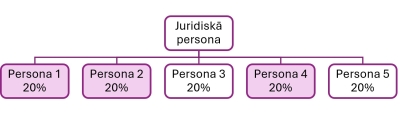
Although no individual natural person owns more than 25% of the shares or voting rights in the company, Natural Persons No. 1, No. 2 and No. 4 always vote together at shareholders’ meetings and consistently outvote the remaining shareholders. Accordingly, each of these persons should be identified as a BO.
- Step No.2
Where it is not possible to identify a person exercising control through ownership rights, or where there are doubts that such persons are in fact the ultimate beneficial owners, persons exercising control should be identified through other means, such as personal influence, financial influence or beneficial interests.
Example No.2 (LV):
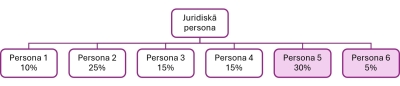
Natural Person No. 6 is the Chairperson of the Management Board of EFG Bank, which is the largest source of financing for the company. Although Natural Person No. 6 owns less than 25% of the shares, that person exercises effective control through EFG Bank, which approves financing requests and authorises the use of funds. Accordingly, Natural Person No. 6 should be regarded as a BO exercising effective control over the company. Natural Person No. 5, in turn, should be regarded as a BO exercising control through direct ownership rights.
- Step No.3
Only where both of the above measures have been implemented and it is still not possible to identify the BO of the legal person, a status stating that “the BO of the legal person cannot be identified” shall be registered with the Enterprise Register in accordance with Section 18.2(2) of the Law, indicating the grounds for such conclusion, or the persons holding positions in the highest management body shall be registered as the BOs of the legal person.
At the same time, it should be noted that, pursuant to Section 18(7) of the Law, in cases where the BO of a legal person cannot be identified, the entities referred to in Section 3 of the Law (for example, credit institutions, outsourced accountants, sworn notaries and others) may regard as the BO the person holding a position in the highest management body of that legal person. Accordingly, where information has been registered with the Enterprise Register stating that the BO of a legal person cannot be identified, the legal person, when completing customer due diligence questionnaires (for example, for a credit institution), will be required to indicate one, several or all members of the management board as BOs, depending on the assessment of the relevant obliged entity and the circumstances of the case.
Please note that the management board of a legal person is responsible for identifying the BO and notifying the Enterprise Register accordingly.
The registration of BO status — whether with the Enterprise Register or, for example, by a credit institution as part of customer due diligence procedures — does not in itself create any additional rights or obligations for the BO.
The previous practice of the Enterprise Register regarding the registration of information on beneficial owners (hereinafter – the BOs) in connection with the registration of the liquidation of a legal person was based on the assumption that such information remained unchanged. It was considered that, once liquidation proceedings had commenced, information on the BO became of secondary importance, as the legal entity would most likely be removed from the registers maintained by the Enterprise Register. Consequently, there was no need to require a legal person or partnership to submit updated information regarding its BOs. Information on BOs was updated only if the legal entity decided to resume its activities.
However, following a review of the requirements contained in the applicable legislation, as well as the obligation of the Enterprise Register, as a public register, to ensure that information on the BOs of legal persons and partnerships is accurate, adequate and up-to-date, it was concluded that the existing registration practice required revision. The current practice of the Enterprise Register in this regard is set out in Decision No. 1‑5n/181 of 13 August 2025 of the Chief State Notary of the Enterprise Register.
Section 1(5)(a) of the Law on the Prevention of Money Laundering and Terrorism and Proliferation Financing (hereinafter – the Law) provides the definition of a BO in relation to legal persons. Namely, in the case of legal persons, a BO is the natural person who, through direct or indirect ownership, owns more than 25% of the shares or voting shares of the legal person or who directly or indirectly exercises control over it.
In the Financial Action Task Force (FATF) Guidance on Beneficial Ownership of Legal Persons, issued in March 2023, a BO is defined as the natural person who ultimately owns or controls the “customer” and/or the natural person on whose behalf a transaction is being conducted. The definition also includes those persons who exercise ultimate control over a legal person. The terms “ultimately owns or controls” and “exercises ultimate control” refer to situations in which ownership or control is exercised through ownership interests or by other means of control that do not constitute direct control. An essential feature of the BO definition is that it extends beyond legal ownership and formal control. The FATF definition focuses on the natural person who ultimately owns the legal person and who exercises the powers of senior management or controls the assets of the legal person, as well as the natural person who actually exercises control over the legal person, regardless of whether that person holds a formal position within the legal person.
Pursuant to Section 18.1(1) of the Law, where a natural person has reason to believe that he or she has become the BO of a legal person or partnership, that person is required to notify the legal person or partnership thereof without delay. Likewise, a person through whom a BO exercises control over a legal person or partnership must provide the legal person or partnership with any information known to that person concerning the BO. Pursuant to Sections 18.1(2) and 18.1(3) of the Law, a legal person or partnership is required, on its own initiative, to ascertain and identify its BOs where it has reasonable grounds to doubt the information provided to it or where no such information has been provided, but there are grounds to believe that a BO exists. The legal person or partnership is also required to maintain and continuously update the information referred to in Section 18.1(4) of the Law, namely identifying information, as well as information and documentary evidence concerning the control exercised, including documentation relating to the entities through which such control is exercised.
Pursuant to Section 18.2(1) of the Law, a legal person or partnership registered in the registers maintained by the Enterprise Register must, without delay and no later than within 14 days from the date on which the relevant information became known, submit an application to the Enterprise Register for the registration of information regarding the BO or the registration of changes thereto, specifying the information referred to in Section 18.1(4) of the Law. Furthermore, Section 18.2(2) of the Law specifies situations in which registration of changes is not possible unless information regarding the BO is registered or updated. These include applications for the registration (incorporation) of a legal person or partnership, changes in the shareholders (members) and members of the management board of a capital company, or changes in the composition of the management bodies and authorised representatives of other legal persons or partnerships.
Taking the above into account, it follows that the applicable legislation imperatively establishes the minimum scope of information that every legal person is required to maintain and, where relevant circumstances arise, submit to the Enterprise Register. This obligation applies throughout the entire existence of the legal entity, irrespective of whether it is carrying out normal business activities, undergoing liquidation, or participating in a reorganisation process.
Capital Companies
Section 312 of the Commercial Law provides that a capital company (hereinafter – the company) ceases to operate:
- by a decision of the shareholders;
- by a court judgment;
- upon commencement of bankruptcy proceedings;
- upon expiry of the term specified in the articles of association (if the company was established for a fixed term);
- upon achievement of the objectives specified in the articles of association (if the company was established for the achievement of specific objectives);
- in other cases provided for by law or the articles of association.
Section 317(1) of the Commercial Law further provides that, where the activities of a company are terminated, the company shall be liquidated unless otherwise provided by law. Accordingly, unless the company is removed from the Commercial Register pursuant to Section 317(2) of the Commercial Law, it is required to undergo liquidation in accordance with the procedure laid down in the Commercial Law.
Liquidation is carried out by the members of the management board unless otherwise provided in the articles of association, a decision of the shareholders’ meeting, or a court judgment (Section 318(1) of the Commercial Law). A liquidator may also be appointed by a court or the commercial registry authority upon application by a person interested in the liquidation of the company (Section 318.1(1) of the Commercial Law). Liquidation may be carried out by one or more liquidators (Section 318(4) of the Commercial Law). Upon appointment, the liquidator assumes all rights and obligations of the management board and the supervisory board that are not incompatible with the purpose of liquidation (Section 322(1) of the Commercial Law), including the obligation to ensure compliance with Sections 18.1 and 18.2 of the Law, i.e. to identify and update information regarding the company’s BOs.
Thus, although the legal person continues to be owned by natural and/or legal persons, those persons no longer exercise the shareholder rights provided for in the Commercial Law — the executive body is no longer appointed because its functions are assumed by the liquidator, and the company’s ordinary business activities are no longer carried out. The liquidator assumes effective control of the company for the purpose of recovering debts, disposing of the company’s assets and satisfying creditors’ claims. Consequently, where, for example, the company’s shareholders were previously registered as the company’s BOs, such information ceases to be accurate from the moment the liquidator assumes effective control of the legal person, since those persons no longer exercise control over it. This also applies where the registered status is that the BO of the legal person cannot be identified or that the BO is a shareholder of a listed joint stock company.
Pursuant to Section 18.2(2) of the Law, when submitting an application to the Enterprise Register regarding changes in the composition of the management board of a capital company, information regarding the BO must be provided in accordance with that Section and Section 18.1(4) of the Law. As registration of the commencement of liquidation simultaneously entails registration of changes in the management board of the company, current information regarding the company’s BO must also be registered. Accordingly, unless other circumstances are established, the liquidator may be regarded as the company’s BO, taking into account the effective control exercised by the liquidator during the liquidation process.
Where liquidation is carried out by several members of the management board (pursuant to Section 322(4) of the Commercial Law, in such cases the liquidators may represent the company only jointly), all liquidators must be registered as BOs without applying the 25% threshold provided for in the Law. This means that, regardless of the number of liquidators (for example, “3” or “5”), all appointed liquidators qualify as BOs due to the effective control they exercise during the liquidation process.
When registering the manner in which the BO exercises control, the following options may be used: “as a representative of the executive or administrative body” or “other form of control: as liquidator” – both of the above forms of control are considered appropriate.
If, for example, the liquidation is carried out by a shareholder of the company who was also its sole member of the management board, and the information originally registered regarding that person as a BO stated that the person “exercises control as a shareholder”, then, even though the natural person exercising control over the legal person remains unchanged, the manner of control should nevertheless be updated by replacing control “as a shareholder” with “as a representative of the executive or administrative body” or “other form of control: as liquidator”.
It should also be noted that no additional state fee is payable for updating information on the BO in this case, as the relevant changes are an integral part of the registration of the company’s liquidation process, for which a state fee has already been paid.
European Companies (SEs)
The liquidation of a European Company is governed by the provisions of the Commercial Law relating to the liquidation of joint stock companies.
Section 312 of the Commercial Law provides that a capital company (hereinafter – the company) ceases to operate:
- by a decision of the shareholder;
- by a court judgment;
- upon commencement of bankruptcy proceedings;
- upon expiry of the term specified in the articles of association (if the company was established for a fixed term);
- upon achievement of the objectives specified in the articles of association (if the company was established for the achievement of specific objectives);
- in other cases provided for by law or the articles of association.
Upon appointment, the liquidator assumes all rights and obligations of the management board and supervisory board that are not incompatible with the purpose of liquidation (Section 322(1) of the Commercial Law), including the obligation to ensure compliance with Sections 18.1 and 18.2 of the Law, i.e. to identify and update information regarding the company’s BOs. Accordingly, although the European Company continues to be owned by legal persons (its owners), those persons no longer exercise the shareholder rights provided for in the Commercial Law — the executive body is no longer appointed because its functions are assumed by the liquidator, and the company’s ordinary operations are no longer carried out. The liquidator assumes effective control of the company for the purpose of recovering debts, disposing of company assets and satisfying creditors’ claims. Consequently, where, for example, information regarding the executive bodies of shareholder legal persons or their ultimate owners had previously been registered as BOs of the European Company, such information ceases to be accurate once the liquidator assumes effective control of the European Company, since those persons no longer exercise control over the legal person. This likewise applies where the registered status is that the BO of the legal person cannot be identified or that the BO is a shareholder of a listed joint stock company.
Pursuant to Section 18.2(2) of the Law, when submitting an application to the Enterprise Register regarding changes in the composition of the management board of a European Company, information regarding the BO must be provided in accordance with that Section and Section 18.1(4) of the Law. As registration of the commencement of liquidation of a European Company simultaneously entails registration of changes in the composition of its management board, current information regarding its BO must also be registered. Accordingly, unless other circumstances are established, the liquidator may be regarded as the BO of the European Company, taking into account the effective control exercised during the liquidation process.
If liquidation is carried out by several members of the management board (pursuant to Section 322(4) of the Commercial Law, in which case the liquidators may represent the company only jointly), all liquidators must be registered as BOs, without applying the 25% threshold provided for in the Law. This means that, regardless of the number of liquidators (for example, “3” or “5”), all of them qualify as BOs, taking into account the effective control they exercise during the liquidation process.
When registering the manner in which the BO exercises control, the following options may be used: “as a representative of the executive or administrative body” or “other form of control: as liquidator” – both forms of control are considered appropriate.
It should also be noted that no additional state fee is payable for updating information on the BO in this case, as the relevant changes form an integral part of the registration of the liquidation process of the European Company, for which a state fee has already been paid.
Individual (Family) Enterprises and Farmer’s or Fisherman’s Farms
Section 21(2) of the Law on Individual (Family) Enterprises and Farmer’s or Fisherman’s Farms provides that the liquidation of an individual (family) enterprise and a farmer’s or fisherman’s farm (hereinafter – the enterprise) is carried out by the owner of the enterprise or by a liquidator appointed by the owner. A decision to commence the liquidation of the enterprise is taken by the owner or, where the enterprise has been established on the basis of family joint ownership, by the adult family members (co-owners) (Section 21(3) of the Law on Individual (Family) Enterprises and Farmer’s or Fisherman’s Farms). As noted above, during the liquidation process the liquidator carries out all actions necessary to fully satisfy all lawful claims of creditors (Section 21(4) of the Law on Individual (Family) Enterprises and Farmer’s or Fisherman’s Farms).
Pursuant to Section 18.2(2) of the Law, when submitting an application to the Enterprise Register regarding changes in the composition of the management bodies and authorised representatives of other legal persons or partnerships, information regarding the BO must be provided in accordance with that Section and Section 18.1(4) of the Law. As registration of the commencement of liquidation of the enterprise simultaneously results in changes to the management structure of the enterprise, current information regarding the enterprise’s BO must also be registered. Accordingly, unless other circumstances are established, the liquidator may be regarded as the BO of the enterprise, taking into account the effective control exercised during the liquidation process.
In practice, liquidation will most commonly be carried out by the owner (for an active entity, the position within the management body is recorded as “owner”). Notwithstanding the specific structure of the enterprise, namely that the same person is usually involved both in carrying on the business and in the liquidation, the manner of control should nevertheless be updated by replacing the registered control “as owner” with “other form of control: as liquidator”. If liquidation is carried out by another person, the manner of control for the BO should be indicated as “other form of control: as liquidator”.
It should also be noted that no additional state fee is payable for updating information on the BO in this case, as the relevant changes are an integral part of the registration of the liquidation process of the enterprise, for which a state fee has already been paid.
Cooperative Societies
Section 67 of the Cooperative Societies Law provides that a society (hereinafter – the cooperative society) is dissolved:
- by a resolution of the members’ meeting;
- by a decision of the management board;
- by a court judgment;
- by a decision of the Enterprise Register;
- by a decision of the State Revenue Service;
- in accordance with legal acts governing insolvency matters;
- in other cases provided for by law.
Section 71(1) of the Cooperative Societies Law further provides that where the operation of a cooperative society has been terminated, liquidation shall take place. Accordingly, unless the cooperative society is removed from the Register of Enterprises Journal pursuant to Section 71(2) of the Cooperative Societies Law, it is required to undergo liquidation in accordance with the procedure laid down in the Cooperative Societies Law.
Liquidation is carried out by the members of the management board unless otherwise provided by law, the articles of association or a resolution of the members’ meeting (Section 73 of the Cooperative Societies Law). A liquidator may also be appointed by the commercial registry authority on the application of a person interested in the liquidation of the cooperative society (Section 74(1) of the Cooperative Societies Law). The liquidation of a cooperative society may be carried out by one or more liquidators (Section 72(6) of the Cooperative Societies Law). Upon appointment, the liquidator assumes all rights and obligations of the management board and supervisory board that are not incompatible with the purpose of liquidation (Section 72(1) of the Cooperative Societies Law), including the obligation to ensure compliance with Sections 18.1 and 18.2 of the Law, i.e. to identify and update information regarding the cooperative society’s BOs.
Thus, although the legal person continues to be owned by natural and/or legal persons, those persons no longer exercise the rights of members provided for in the Cooperative Societies Law – their functions are assumed by the liquidator and the ordinary activities of the cooperative society are no longer carried out. The liquidator assumes effective control of the cooperative society for the purpose of recovering debts, satisfying creditors’ claims and distributing the remaining assets of the society among the persons entitled thereto. Consequently, where, for example, members had previously been registered as the BOs of the cooperative society, such information ceases to be accurate from the moment the liquidator assumes effective control of the legal person, since those persons no longer exercise control over the cooperative society. This also applies where the registered status is that the BO of the legal person cannot be identified or that the BO of the legal person is a shareholder of a listed joint stock company.
Pursuant to Section 18.2(2) of the Law, when submitting an application to the Enterprise Register regarding changes in the composition of the management bodies and authorised representatives of other legal persons or partnerships, information regarding the BO must be provided in accordance with that Section and Section 18.1(4) of the Law. It should be noted that registration of the commencement of liquidation of a cooperative society also involves changes in the composition of the management board of the cooperative society and, therefore, information regarding the BO of the cooperative society must be registered simultaneously. Accordingly, unless other circumstances are established, the liquidator may be regarded as the BO of the cooperative society, taking into account the effective control exercised during the liquidation process.
If liquidation is carried out by several members of the management board (pursuant to Section 72(6) of the Cooperative Societies Law, in which case the liquidators may represent the society only jointly), all liquidators must be registered as BOs, without applying the 25% threshold provided for in the Law. This means that, regardless of the number of liquidators (for example, “3” or “5”), all of them qualify as BOs, taking into account the effective control they exercise during the liquidation process.
When registering the manner in which the BO exercises control, the following options may be used: “as a representative of the executive or administrative body” or “other form of control: as liquidator” – both of the above forms of control are considered appropriate.
It should also be noted that no additional state fee is payable for the registration of information on the BO in this case, as the relevant changes are an integral part of the registration of the liquidation process of the cooperative society, for which a state fee has already been paid.
Partnerships (General Partnerships and Limited Partnerships)
Section 97 of the Commercial Law provides that a partnership (hereinafter – the partnership) is dissolved:
- upon expiry of the term for which it was established;
- by a decision of the partners;
- upon commencement of bankruptcy proceedings;
- by a court judgment.
Section 106 of the Commercial Law further provides that, following the dissolution of a partnership, liquidation shall take place, except where the partnership agreement provides for a different method of final settlement or where the partnership has been declared insolvent. Liquidation is carried out by a liquidator selected by the partners of the partnership (as follows from Section 107(1) of the Commercial Law). A partnership may be liquidated by several liquidators, who are entitled to carry out activities related to the liquidation only jointly, unless it is provided that the liquidators may carry out such activities separately.
Upon appointment, the liquidator assumes the rights and obligations of the partners, unless otherwise provided by law (for example, Section 110 of the Commercial Law), including the obligation to ensure compliance by the partnership with Sections 18.1 and 18.2 of the Law, i.e. to identify and update information regarding the partnership’s BOs. Thus, although the partnership continues to be owned by natural and/or legal persons, those persons no longer exercise the rights of partners provided for in the Commercial Law – no changes are made to the composition of the partners or to the scope of their representation rights (the position in the management body is held by the liquidator), and, accordingly, the ordinary activities of the partnership are no longer carried out. The liquidator has assumed effective control of the partnership in order to carry out all necessary actions for the recovery of debts, the sale of the partnership’s assets and the satisfaction of creditors’ claims. Consequently, where, for example, partners (a general partner or personally liable partners who have not been deprived of the right to conduct the affairs of the partnership pursuant to Section 85(1) of the Commercial Law) had been registered as the partnership’s BOs before the commencement of the liquidation process, such information ceases to be accurate from the moment the liquidator assumes effective control of the partnership, since those persons no longer exercise control over the legal entity. This also applies where the registered status is that the partnership’s BO cannot be identified or that the BO of the legal person is a shareholder of a listed joint stock company.
Pursuant to Section 18.2(2) of the Law, when submitting an application to the Enterprise Register regarding changes in the management bodies of a partnership, information regarding the BO must be provided in accordance with that Section and Section 18.1(4) of the Law. As registration of the commencement of liquidation of a partnership also involves changes to the representation structure of the partnership, current information regarding the partnership’s BO must likewise be registered. Accordingly, unless other circumstances are established, the liquidator may be regarded as the partnership’s BO, taking into account the effective control exercised during the liquidation process.
If liquidation is carried out by several liquidators (pursuant to Section 108(1) of the Commercial Law, in which case the liquidators may represent the partnership only jointly), all liquidators must be registered as BOs, without applying the 25% threshold provided for in the Law. This means that, regardless of the number of liquidators (for example, “3” or “5”), all liquidators qualify as BOs, taking into account the effective control they exercise during the liquidation process.
When registering the manner in which the BO exercises control, the designation “other form of control: as liquidator” shall be used.
It should also be noted that no additional state fee is payable for the registration of information on the BO in this case, as the relevant changes are an integral part of the registration of the liquidation process of the partnership, for which a state fee has already been paid.
European Economic Interest Groupings
The legal framework governing the registration and operation of general partnerships (partnerships), including liquidation proceedings, also applies to European Economic Interest Groupings.
Thus, although a European Economic Interest Grouping continues to be owned by natural and/or legal persons, those persons no longer exercise the rights of members provided for in the Commercial Law – no changes are made to the management structure and, accordingly, the ordinary activities of the European Economic Interest Grouping are no longer carried out, because the liquidator has assumed effective control of the grouping in order to carry out all necessary actions for the recovery of debts, the sale of the grouping’s assets and the satisfaction of creditors’ claims. Consequently, where, for example, members or the executive bodies or owners of member legal persons had been registered as the grouping’s BOs before the commencement of liquidation proceedings, such information ceases to be accurate from the moment the liquidator assumes effective control of the grouping, as those persons no longer exercise control over the legal entity. This also applies where the registered status is that the BO of the legal person cannot be identified or that the BO of the legal person is a shareholder of a listed joint stock company.
Pursuant to Section 18.2(2) of the Law, when submitting an application to the Enterprise Register regarding changes in the management bodies of a European Economic Interest Grouping, information regarding the BO must be provided in accordance with that Section and Section 18.1(4) of the Law. As registration of the commencement of liquidation of the grouping simultaneously involves changes in its management structure, current information regarding the grouping’s BO must also be registered. Accordingly, unless other circumstances are established, the liquidator may be regarded as the BO of the European Economic Interest Grouping, taking into account the effective control exercised during the liquidation process.
If liquidation is carried out by several liquidators (pursuant to Section 108(1) of the Commercial Law, in which case the liquidators may represent the partnership only jointly), all liquidators must be registered as BOs, without applying the 25% threshold provided for in the Law. This means that, regardless of the number of liquidators (for example, “3” or “5”), all liquidators qualify as BOs, taking into account the effective control they exercise during the liquidation process.
When registering the manner in which the BO exercises control, the following options may be used: “as manager” or “other form of control: as liquidator” – both of the above forms of control are considered appropriate.
It should also be noted that no additional state fee is payable for the registration of information on the BO in this case, as the relevant changes are an integral part of the registration of the liquidation process of the grouping, for which a state fee has already been paid.
Associations
Section 53(1) of the Associations and Foundations Law provides that an association ceases to exist:
- by a resolution of the members’ meeting;
- upon commencement of bankruptcy proceedings of the association;
- where the number of members is reduced to one member or to another number specified in the articles of association;
- upon expiry of the term specified in the articles of association (if the association was established for a fixed term);
- by a decision of the Enterprise Register authority;
- by a decision of the State Revenue Service;
- by a court judgment;
- on another ground provided for by law or the articles of association.
Section 58(1) of the Associations and Foundations Law further provides that, where the activities of an association are terminated, liquidation shall take place unless otherwise provided by law. Accordingly, unless the association is removed from the Register of Associations and Foundations pursuant to Section 56.1 of the Associations and Foundations Law, the association is required to undergo liquidation in accordance with the procedure laid down in the Associations and Foundations Law.
Liquidation is carried out by the members of the management board unless otherwise provided in the articles of association, a resolution of the members’ meeting or a court judgment (Section 59(1) of the Associations and Foundations Law). A liquidator may also be appointed by the registration authority upon application by a person interested in the liquidation of the association (Section 59.1(1) of the Associations and Foundations Law). Upon appointment, the liquidator assumes all rights and obligations of the management board that are not incompatible with the purpose of liquidation (Section 62(1) of the Associations and Foundations Law), including the obligation to ensure compliance with Sections 18.1 and 18.2 of the Law, i.e. to identify and update information regarding the association’s BOs.
Thus, although the association continues to consist of and be operated by members – natural and/or legal persons – those persons no longer exercise the rights of members provided for in the Associations and Foundations Law, as the executive body is no longer appointed because its functions are assumed by the liquidator, and the ordinary operation of the association is no longer ensured. The liquidator assumes effective control of the association in order to carry out all necessary actions for the recovery of debts, the sale of the association’s assets and the satisfaction of creditors’ claims. Consequently, where, for example, members had been registered as the association’s BOs before the commencement of liquidation proceedings, such information ceases to be accurate from the moment the liquidator assumes effective control of the association, since those persons no longer exercise control over it. This also applies to the registered status that the BO of the legal person cannot be identified.
Pursuant to Section 18.2(2) of the Law, when submitting an application to the Enterprise Register regarding changes in the members of the management board of a legal person, information regarding the BO must be provided in accordance with that Section and Section 18.1(4) of the Law. As registration of the commencement of liquidation of an association simultaneously involves changes in the composition of the management board of the association, current information regarding the association’s BO must likewise be registered. Accordingly, unless other circumstances are established, the liquidator may be regarded as the association’s BO, taking into account the effective control exercised during the liquidation process.
If liquidation is carried out by several members of the management board (pursuant to Section 59(1) of the Associations and Foundations Law, in which case the liquidators may represent the association only jointly), all liquidators must be registered as BOs, which means that regardless of the number of liquidators (for example, “3” or “5”), all liquidators qualify as BOs, taking into account the effective control they exercise during the liquidation process.
When registering the manner in which the BO exercises control, the following options may be used: “as a representative of the executive or administrative body” or “other form of control: as liquidator” – both of the above forms of control are considered appropriate.
It should also be noted that no additional state fee is payable for the registration of information on the BO in this case, as the relevant changes are an integral part of the registration of the liquidation process of the association, for which a state fee has already been paid.
Foundations and Funds
Section 104 of the Associations and Foundations Law provides that a foundation ceases to exist:
- by a court judgment;
- upon expiry of the term (if the foundation was established for a fixed term);
- by a decision of the management board;
- upon commencement of bankruptcy proceedings of the foundation;
- by a decision of the Enterprise Register authority;
- by a decision of the State Revenue Service;
- on another ground provided for by law or the articles of association.
Section 107(1) of the Associations and Foundations Law further provides that, where the activities of a foundation are terminated, liquidation shall take place in accordance with the provisions of Chapter VI of the Associations and Foundations Law governing the liquidation of associations, insofar as not otherwise provided. Accordingly, unless the foundation is removed from the Register of Associations and Foundations pursuant to Section 56.1 of the Associations and Foundations Law, the foundation is required to undergo liquidation in accordance with the procedure laid down in the Associations and Foundations Law.
Liquidation is carried out by the members of the management board unless otherwise provided in the articles of association. Where liquidation is carried out by persons other than members of the management board, the articles of association must provide for the procedure for appointing such liquidators (Section 107(2) of the Associations and Foundations Law). Upon appointment, the liquidator assumes all rights and obligations of the management board, including the obligation to identify the BOs of the foundation (foundation under liquidation). Thus, although the foundation continues to belong to natural and/or legal persons, those persons no longer exercise the rights of founders or other institutions provided for in the articles of association under the Associations and Foundations Law – the executive body is not appointed (the position in the executive body being held by the liquidator), the ordinary operation of the foundation is not ensured, and the liquidator has assumed effective control of the legal person in order to carry out all necessary actions for the recovery of debts, the sale of the foundation’s assets and the satisfaction of creditors’ claims. Consequently, where, for example, persons identified in accordance with Section 1(5)(b) of the Law had been registered as the foundation’s BOs before the commencement of liquidation proceedings, such information ceases to be accurate from the moment the liquidator assumes effective control of the foundation, since those persons no longer exercise control over the foundation.
Pursuant to Section 18.2(2) of the Law, when submitting an application to the Enterprise Register regarding changes in the members of the management board of a legal person, information regarding the BO must be provided in accordance with that Section and Section 18.1(4) of the Law. As registration of the commencement of liquidation of a foundation simultaneously involves changes in the composition of the management board of the foundation, current information regarding the foundation’s BO must likewise be registered. Accordingly, unless other circumstances are established, the liquidator may be regarded as the foundation’s BO, taking into account the effective control exercised during the liquidation process.
If liquidation is carried out by several members of the management board (pursuant to Section 59(1) of the Associations and Foundations Law), all liquidators must be registered as BOs, which means that regardless of the number of liquidators (for example, “3” or “5”), all members of the management board qualify as BOs, taking into account the effective control they exercise during the liquidation process.
When registering the manner in which the BO exercises control, the following options may be used: “as a representative of the executive or administrative body” or “other form of control: as liquidator” – both of the above forms of control are considered appropriate.
It should also be noted that no additional state fee is payable for the registration of information on the BO in this case, as the relevant changes are an integral part of the registration of the liquidation process of the foundation, for which a state fee has already been paid.
Trade Unions, Their Associations and Independent Units
Section 2(2) of the Trade Union Law provides that the activities of a trade union (hereinafter – the trade union) are governed by that Law, the provisions of the Associations and Foundations Law relating to associations insofar as the Trade Union Law does not provide otherwise, and the statutes of the trade union.
Section 53(1) of the Associations and Foundations Law provides that an association ceases to exist:
- by a resolution of the members’ meeting;
- upon commencement of bankruptcy proceedings of the association;
- where the number of members is reduced to one member or to another number specified in the articles of association;
- upon expiry of the term specified in the articles of association (if the association was established for a fixed term);
- by a decision of the Enterprise Register authority;
- by a decision of the State Revenue Service;
- by a court judgment;
- on another ground provided for by law or the articles of association.
Section 58(1) of the Associations and Foundations Law further provides that, where the activities of an association are terminated, liquidation shall take place unless otherwise provided by law. Accordingly, unless the trade union is removed from the Register of Associations and Foundations pursuant to Section 56.1 of the Associations and Foundations Law, the trade union is required to undergo liquidation in accordance with the procedure laid down in the Associations and Foundations Law.
Liquidation is carried out by the members of the management board unless otherwise provided in the articles of association, a resolution of the members’ meeting or a court judgment (Section 59(1) of the Associations and Foundations Law). A liquidator may also be appointed by the registration authority upon application by a person interested in the liquidation of the trade union (Section 59.1(1) of the Associations and Foundations Law). Upon appointment, the liquidator assumes all rights and obligations of the management board that are not incompatible with the purpose of liquidation (Section 62(1) of the Associations and Foundations Law), including the obligation to ensure compliance with Sections 18.1 and 18.2 of the Law, i.e. to identify and update information regarding the trade union’s BOs.
Thus, although the trade union (association of trade unions) continues to belong to natural and/or legal persons, those persons no longer exercise the rights of members provided for in the Associations and Foundations Law – the executive body is no longer appointed because its functions are assumed by the liquidator, and the ordinary operation of the trade union is no longer ensured. The liquidator assumes effective control of the trade union in order to carry out all necessary actions for the recovery of debts, the sale of the association’s assets and the satisfaction of creditors’ claims. Consequently, where, for example, members had been registered as the trade union’s BOs before the commencement of liquidation proceedings, such information ceases to be accurate from the moment the liquidator assumes effective control of the trade union, since those persons no longer exercise control over the trade union. This also applies to the registered status that the BO of the legal person cannot be identified.
Pursuant to Section 18.2(2) of the Law, when submitting an application to the Enterprise Register regarding changes in the members of the management board of a legal person, information regarding the BO must be provided in accordance with that Section and Section 18.1(4) of the Law. As registration of the commencement of liquidation of a trade union simultaneously involves changes in the composition of the management board of the trade union, current information regarding the trade union’s BO must likewise be registered. Accordingly, unless other circumstances are established, the liquidator may be regarded as the trade union’s BO, taking into account the effective control exercised during the liquidation process.
If liquidation is carried out by several members of the management board (pursuant to Section 59(1) of the Associations and Foundations Law, in which case the liquidators may represent the trade union only jointly), all liquidators must be registered as BOs, which means that regardless of the number of liquidators (for example, “3” or “5”), all liquidators qualify as BOs, taking into account the effective control they exercise during the liquidation process.
When registering the manner in which the BO exercises control, the following options may be used: “as a representative of the executive or administrative body” or “other form of control: as liquidator” – both of the above forms of control are considered appropriate.
It should also be noted that no additional state fee is payable for the registration of information on the BO in this case, as the relevant changes are an integral part of the registration of the liquidation process of the trade union, for which a state fee has already been paid.
Political Parties and Associations of Political Parties
Section 41 of the Political Parties Law provides that a political party and an association of political parties (hereinafter – the party) ceases to exist:
- by a resolution of the members’ meeting of the party on the termination of the party’s activities;
- upon commencement of bankruptcy proceedings of the party;
- where the number of members of the party falls below 150 members or another number specified in the party’s statutes (Section 44);
- upon expiry of the term specified in the party’s statutes, if the party was established for a fixed period;
- by a court judgment;
- on another basis specified in the statutes.
Section 46 of the Political Parties Law provides that, where the activities of a party are terminated, liquidation shall take place unless otherwise provided by law, and matters relating to the liquidation of a party shall be governed by the Associations and Foundations Law. Liquidation is carried out by the members of the management board unless otherwise provided in the statutes, a resolution of the members’ meeting or a court judgment (Section 59(1) of the Associations and Foundations Law). Upon appointment, the liquidator assumes all rights and obligations of the management board that are not incompatible with the purpose of liquidation (Section 62(1) of the Associations and Foundations Law), including the obligation to ensure compliance by the political party with Sections 18.1 and 18.2 of the Law, i.e. to identify and update information regarding the party’s BOs.
Thus, although the party continues to belong to (consist of) natural persons, those persons no longer exercise the membership rights provided for in the Political Parties Law – the executive body is no longer appointed (the office of the executive body is held by the liquidator), the ordinary activities of the party are no longer ensured, and the liquidator has assumed effective control of the party in order to carry out all necessary actions for the recovery of debts, the sale of the party’s assets and the satisfaction of creditors’ claims. Consequently, where, for example, before the commencement of liquidation proceedings the party had registered the status that the BO could not be identified, such information ceases to be accurate from the moment the liquidator assumes effective control of the legal person.
Pursuant to Section 18.2(2) of the Law, when submitting an application to the Enterprise Register regarding changes in the members of the management board of a legal person, information regarding the BO must be provided in accordance with that Section and Section 18.1(4) of the Law. As registration of the commencement of liquidation of a political party simultaneously involves changes in the composition of its management board, current information regarding the political party’s BO must also be registered. Accordingly, unless other circumstances are established, the liquidator may be regarded as the party’s BO, taking into account the effective control exercised during the liquidation process.
If liquidation is carried out by several members of the management board (pursuant to Section 59(1) of the Associations and Foundations Law, in which case the liquidators may represent the Party only jointly), all liquidators must be registered as BOs, which means that, regardless of the number of liquidators (for example, “3” or “5”), all liquidators qualify as BOs, taking into account the effective control they exercise during the liquidation process.
When registering the manner in which the BO exercises control, the following options may be used: “as a representative of the executive or administrative body” or “other form of control: as liquidator” – both of the above forms of control are considered appropriate.
It should also be noted that no additional state fee is payable for the registration of information on the BO in this case; changes to information regarding the party’s BO form part of the information submitted for the commencement of the liquidation process, in respect of which a state fee has already been prescribed.
On 1 July 2020, amendments to the Law on the Prevention of Money Laundering and Terrorism and Proliferation Financing (hereinafter – the Law) entered into force, introducing a specific framework for information exchange between public authorities and entities subject to the Law, such as outsourced accountants, lawyers, insolvency administrators, banks and others. Since 1 June 2020, the Enterprise Register has operated a Beneficial Owner Reporting Tool (hereinafter – the BO Reporting Tool), through which entities subject to the Law, as well as supervisory and control authorities (hereinafter – SCAs) and their authorised representatives, submit notifications pursuant to Section 18(3¹) of the Law regarding information on the beneficial owner (hereinafter – the BO) of a legal person (client) that may be inaccurate. In order to ensure a uniform approach by entities subject to the Law and SCAs in situations where information on BOs registered in the registers maintained by the Enterprise Register may be inaccurate, the Enterprise Register has developed corresponding guidelines.
Amendments to the legislation have expanded the range of entities required to submit applications to the Enterprise Register for the registration of information regarding their BOs. In addition, a new register has been established — the Register of Beneficial Owners of Legal Arrangements. Given that customer due diligence carried out by entities subject to the Law also applies to foreign entities wishing to operate in Latvia and to apartment owners’ associations participating in civil transactions, entities subject to the Law and SCAs are also required to submit notifications regarding the BOs of legal arrangements, foreign legal persons and apartment owners’ associations. It should be noted, however, that the BO Reporting Tool currently does not support the submission of notifications in relation to the above-mentioned entities. Persons with access to the BO Reporting Tool must submit such notifications to the Enterprise Register in accordance with the procedures set out in the Law on Submissions. Information regarding registered warnings relating to legal arrangements, foreign entities or apartment owners’ associations will be provided by the Enterprise Register to entities subject to the Law and SCAs upon individual request.
Information regarding typographical errors identified in the registers maintained by the Enterprise Register may be submitted both now and in the future. Such errors are corrected in accordance with the Law on the Enterprise Register of the Republic of Latvia. Notifications regarding errors may be submitted by application, signed with a secure electronic signature and sent to pasts@ur.gov.lv.
Entities subject to the Law and SCAs are encouraged to inform the Enterprise Register of identified discrepancies by sending the relevant information to kludas@ur.gov.lv.
No notification should be submitted where the following are identified:
- Transcription or typographical errors in personal data:
- Transcription of personal data from a foreign language, for example, Jakrin and Yakrin.
- Variations in the name of the authority that issued an identification document. For example, an identity document may have been issued by an authority of the Russian Federation, while the Enterprise Register has recorded the issuing authority as FMC, ФМС, The Federal Migration Service, or its Latvian-language equivalent.
- Transliteration or typographical errors in the data of a foreign entity:
- The name of a foreign entity is presented using a national alphabet (e.g. Cyrillic, Arabic or another script), whereas the Enterprise Register has registered the entity using the Latin alphabet. For example, Руссиан Воод has been registered as Russian Wood.
- Identifying information about a foreign entity has been registered using Latin alphabet characters in place of certain original characters. For example, where the legal address of a foreign entity is Alsleben, Germany, Bernburger Straβe, the character “β” may be replaced by “ss”, or the address may be rendered in Latvian.
- Differences in personal identification document details – for example, where the Enterprise Register records an ID card as the identification document of a BO, whereas the entity subject to the Law has passport details available.
The Enterprise Register notes that, pursuant to Paragraph 41 of the Transitional Provisions of the Law, where a legal person had not submitted a separate application for the registration of its BO by 1 July 2019 and information regarding its BO had already been submitted in the fulfilment of obligations imposed by other legislation, and where the manner in which control over the legal person was exercised derived solely from the status of a shareholder in a limited liability company, a partner in a partnership, the owner of an individual enterprise, a farmer’s or fisherman’s farm, or a member of the management board of a foundation, the legal person was deemed to have disclosed its BO. Accordingly, without adopting a separate decision, the Enterprise Register registered those persons as BOs in the relevant registers.
Where, as a result of the automatic registration of BO information (registered during the period from 5 July 2019 to 31 July 2019), information regarding the nationality and/or country of residence of a foreign natural person differed from the actual situation, the legal person was required to apply to the Enterprise Register for the registration of changes to the BO information.
Given that the Enterprise Register registered such information on the basis of the Law, it cannot correct that information on its own initiative. Responsibility for the registration of accurate information (including information registered through the automatic registration process) rests with the legal person.
- Differences in personal identifying data – for example, where a foreign natural person’s residence permit issued by the Republic of Latvia has expired, resulting in the person’s personal identity number becoming inactive, while the Enterprise Register still records that personal identity number under certain legal statuses (management board member, shareholder/member or BO). In such cases, the legal person must apply to the Enterprise Register to update the relevant personal data.
- Differences in information relating to the person through whom the BO exercises control – for example, where the entity through which the BO exercises control has changed its name or registered address, or has been liquidated or reorganised. In such cases, the legal person must apply to the Enterprise Register for registration of changes to the BO information and, where necessary, to the composition of shareholders or members.
Information regarding reports of potentially inaccurate BO information is not publicly available. Access to the BO Reporting Tool, through which such notifications may be submitted and registered warnings may be viewed, is available only to entities subject to the Law, SCAs and law enforcement authorities. Notifications and registered warnings relating to the BOs of legal arrangements, foreign legal persons and apartment owners’ associations are processed manually.
1. Pursuant to Paragraph 42 of the Transitional Provisions of the Law, the Enterprise Register of the Republic of Latvia registers information on the nationality and country of permanent residence of a BO as follows:
- where the person has been assigned a personal identity number, Latvia is registered as the BO’s nationality and country of permanent residence;
- where the person has not been assigned a personal identity number, the nationality and country of permanent residence of the BO are registered as the country that issued the person’s identification document.